
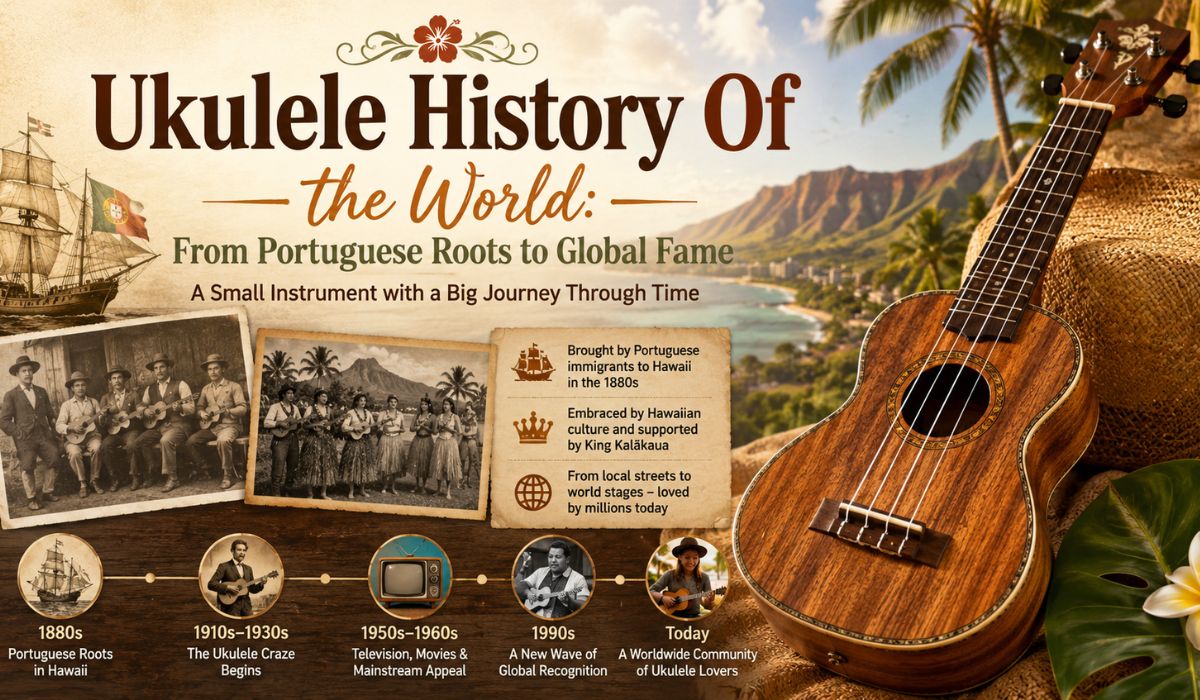
The story of the ukulele is one of migration, cultural exchange, creativity, and global influence. Today, this small four-string instrument is recognized around the world for its cheerful sound and easy playability. From beaches in Hawaii to classrooms in Canada, concert halls in Japan, and online performances viewed by millions, the ukulele has earned a special place in music history.
What makes the instrument especially fascinating is that its journey did not begin in Hawaii, as many people assume. The Ukulele History Of the world actually starts thousands of miles away in Portugal. Through the movement of people, ideas, and traditions, a simple folk instrument evolved into one of the most recognizable musical instruments on Earth.
As we explore the Ukulele History Of the world, we will uncover its Portuguese roots, its transformation in Hawaii, its rise to international fame, and the reasons why it continues to captivate musicians in 2026 and beyond.
Quick Bio Information
| Fact | Information |
|---|---|
| Instrument Family | Lute Family |
| Origin Country | Portugal |
| Cultural Home | Hawaii |
| Developed | 1880s |
| Main Influences | Machete, Cavaquinho, Rajão |
| First Major Makers | Manuel Nunes, José do Espírito Santo, Augusto Dias |
| Typical Strings | Four |
| Standard Tuning | G-C-E-A |
| Traditional Hawaiian Wood | Koa |
| Most Common Sizes | Soprano, Concert, Tenor, Baritone |
| Meaning Of Ukulele | Jumping Flea |
| Key Royal Supporter | King Kalākaua |
| Major Turning Point | 1915 Panama-Pacific Exposition |
| Famous Modern Artist | Israel Kamakawiwoʻole |
| Viral Internet Star | Jake Shimabukuro |
| Educational Use | Schools Worldwide |
| Global Popularity | North America, Europe, Asia, Oceania |
| Modern Materials | Wood, Laminate, Plastic |
| Typical Frets | 16–22 |
| Status In 2026 | One Of The World’s Most Popular Beginner Instruments |
The True Origins Of The Ukulele
The Ukulele History Of begins long before the instrument received its famous Hawaiian name. During the nineteenth century, Portugal had a rich tradition of small stringed instruments used in folk music. Among these instruments were the machete, cavaquinho, and rajão, all of which played an important role in the development of what would eventually become the ukulele.
These instruments were especially popular in Madeira, a Portuguese island located in the Atlantic Ocean. The machete and cavaquinho were small, portable, and easy to play, making them favorites among working-class musicians. Their bright sound and compact size made them ideal companions for social gatherings, celebrations, and community events.
Although these instruments looked different from modern ukuleles in some ways, they shared many similarities. They featured small bodies, multiple strings, and a lively tone that encouraged rhythmic playing. The foundation of the ukulele was already taking shape long before it reached the Pacific Islands.
Portuguese Immigrants Bring Music To Hawaii
One of the most important chapters in Ukulele History Of the world began in 1879. During this period, economic difficulties encouraged many Portuguese families from Madeira to seek opportunities elsewhere. Hawaii, with its growing sugar industry, became an attractive destination.
Thousands of Portuguese immigrants traveled across the ocean to begin new lives. Among them were talented craftsmen and musicians who carried their cultural traditions with them. Three individuals are particularly important in ukulele history: Manuel Nunes, José do Espírito Santo, and Augusto Dias.
These skilled woodworkers and instrument makers brought knowledge of Portuguese stringed instruments to Hawaii. Using local materials and adapting traditional designs, they began building instruments that gradually evolved into what we now recognize as the ukulele.
The arrival of these immigrants demonstrates how music often travels alongside people. Without their journey to Hawaii, the ukulele might never have existed in its modern form.
How Hawaii Shaped The Instrument’s Identity
While Portugal provided the roots, Hawaii gave the ukulele its identity. Hawaiian communities quickly embraced the new instrument because of its pleasant sound, portability, and versatility. It blended naturally with existing musical traditions and became a favorite at gatherings, celebrations, and cultural events.
Hawaiian musicians adapted the instrument to local styles and preferences. Over time, the ukulele developed a unique sound that reflected Hawaiian culture and values. Music became a way to tell stories, celebrate nature, and bring people together.
This cultural adoption transformed the instrument from an immigrant creation into a symbol of Hawaii itself. Today, many people automatically associate the ukulele with Hawaiian music, tropical landscapes, and island hospitality. That connection remains one of the strongest elements of the Ukulele History Of the world.
King Kalākaua And The Rise Of The Ukulele
No discussion of Ukulele History Of would be complete without mentioning King Kalākaua. Known as the “Merrie Monarch,” he was a passionate supporter of Hawaiian culture, music, dance, and the arts.
During his reign in the late nineteenth century, King Kalākaua encouraged cultural expression and helped preserve Hawaiian traditions. He frequently included the ukulele in royal celebrations, performances, and official gatherings.
This royal endorsement gave the instrument prestige and visibility. People throughout Hawaii began viewing the ukulele as an important part of their cultural identity. The king’s support helped accelerate its popularity and ensured that it became deeply woven into Hawaiian society.
Many historians consider King Kalākaua one of the most influential figures in the instrument’s development because he helped elevate it from a local novelty to a respected musical instrument.
The Meaning Behind The Name Ukulele
One of the most frequently discussed topics in Ukulele History Of is the origin of the instrument’s name. The Hawaiian word “ukulele” is commonly translated as “jumping flea.”
The most popular explanation suggests that the name refers to the rapid movement of a player’s fingers across the strings. When viewed from a distance, the fingers appear to jump quickly across the instrument, much like a flea.
Another story connects the name to Edward William Purvis, a British officer who served in the Hawaiian Kingdom. Because of his energetic personality, small stature, and musical abilities, some people believe he inspired the nickname.
Although historians continue to debate the exact origin, the phrase “jumping flea” has become one of the most charming and memorable aspects of ukulele culture.
The Ukulele Begins Its Journey Beyond Hawaii
As Hawaii became increasingly connected to the rest of the world through tourism, trade, and cultural exchange, the ukulele started attracting attention from visitors. Travelers often returned home with stories about Hawaiian music and the charming little instrument that accompanied it.
Performers visiting Hawaii also helped spread awareness. The instrument’s simple design and appealing sound made it easy to transport and demonstrate. Unlike larger instruments, the ukulele could easily travel across oceans and continents.
By the early twentieth century, interest in Hawaiian culture was growing internationally. This growing fascination created the perfect opportunity for the ukulele to move beyond its island home and begin a remarkable global journey.
The Event That Changed Everything In 1915
One of the most important moments in the Ukulele History Of the world occurred during the Panama-Pacific International Exposition held in San Francisco in 1915.
Hawaiian performers showcased traditional music to enormous crowds. Visitors were captivated by the unique sounds of Hawaiian instruments, especially the ukulele. For many Americans, this was their first introduction to Hawaiian music.
The response was overwhelmingly positive. Visitors purchased instruments, sheet music, and recordings. Interest spread rapidly across the United States, creating what historians often describe as the first major ukulele boom.
This event transformed the ukulele from a regional instrument into a national sensation and laid the foundation for its future global success.
The Great Ukulele Craze Of The 1920s And 1930s
Following its breakthrough at the 1915 exposition, the ukulele experienced an extraordinary rise in popularity throughout the 1920s and 1930s. This period is often called the first great ukulele craze. Americans were looking for affordable entertainment, and the ukulele fit perfectly into everyday life. It was inexpensive, portable, and easier to learn than many other instruments.
During the Jazz Age, countless households owned a ukulele. Music publishers even began printing ukulele chord diagrams in sheet music so beginners could quickly learn popular songs. Vaudeville performers, radio entertainers, and traveling musicians embraced the instrument. As a result, the ukulele became a familiar sight in homes, schools, and social gatherings across the United States.
The popularity of the instrument during this era helped establish a strong foundation for future generations. Even as musical trends changed, the ukulele had already secured a place in popular culture.
Surviving Change During The Mid-Twentieth Century
The middle decades of the twentieth century brought both opportunities and challenges for the ukulele. Radio programs, movies, and television appearances helped keep the instrument visible. Entertainers regularly featured it in performances, introducing it to new audiences.
The 1950s saw another boost in popularity thanks to television personalities and Hollywood productions. Affordable plastic ukuleles became widely available, allowing more people to own an instrument. Millions of beginners learned basic chords and songs during this period.
However, the rise of rock and roll in the late 1950s and 1960s changed the music landscape. Electric guitars captured the attention of younger musicians, and the ukulele gradually lost some of its mainstream visibility. While it never disappeared completely, it entered a quieter period that lasted for several decades.
The Modern Ukulele Revival
The Ukulele History Of the modern era is a story of revival and rediscovery. Beginning in the 1980s and continuing throughout the 1990s, musicians and educators started introducing the instrument to new audiences. People began appreciating its simplicity, warm tone, and versatility once again.
A major factor in this revival was the growing interest in acoustic music. Many players wanted instruments that felt personal and approachable. The ukulele offered exactly that. It could be used for traditional Hawaiian music, folk songs, pop hits, jazz standards, and original compositions.
Music festivals, workshops, and ukulele clubs appeared around the world. Communities of players shared techniques, organized performances, and encouraged beginners. This grassroots movement helped transform the instrument from a nostalgic curiosity into a thriving modern phenomenon.
How The Internet Helped Create A New Generation Of Players
The internet dramatically changed the future of the ukulele. Before online video platforms, learning an instrument often required private lessons or printed instruction books. Suddenly, anyone with an internet connection could watch tutorials, performances, and educational content.
One of the most influential moments came when Hawaiian musician Jake Shimabukuro’s performance of “While My Guitar Gently Weeps” became a viral sensation. Millions of viewers were amazed by the skill and musical possibilities of the ukulele.
At the same time, social media platforms allowed players from different countries to connect and share ideas. Online communities made learning easier than ever before. This digital revolution introduced the instrument to younger generations and played a significant role in its worldwide resurgence.
Israel Kamakawiwoʻole And The Sound That Reached The World
Few musicians have had a greater impact on modern ukulele popularity than Israel Kamakawiwoʻole. His heartfelt medley of “Over The Rainbow” and “What A Wonderful World” became one of the most beloved recordings in contemporary music.
The recording showcased the emotional depth of the ukulele. Many people who previously viewed the instrument as simple or playful discovered its ability to express powerful feelings. The song appeared in films, television programs, documentaries, and commercials around the world.
For countless listeners, this recording served as their introduction to Hawaiian music and the ukulele itself. Even in 2026, it remains one of the most influential performances in the history of the instrument.
Ukulele Around The World Today
Today, the ukulele enjoys global popularity unlike anything seen in its earlier history. Players can be found across North America, Europe, Asia, South America, Africa, and Oceania. Music schools, community groups, and professional performers continue to embrace the instrument.
Japan has become one of the world’s most enthusiastic ukulele markets, with festivals, competitions, and dedicated music programs. Canada has integrated the instrument into educational systems, while countries throughout Europe have developed active ukulele communities.
This worldwide acceptance demonstrates the universal appeal of the instrument. Regardless of language, culture, or musical background, people are drawn to its welcoming nature and joyful sound.
The Evolution Of Ukulele Design And Construction
The earliest ukuleles were handcrafted from locally available materials. Hawaiian builders often preferred koa wood, a beautiful hardwood native to the islands. Koa remains highly valued because of its attractive appearance and distinctive tone.
Modern manufacturing has expanded the range of available materials. Many affordable instruments use laminated woods, while premium models often feature solid mahogany, spruce, cedar, or koa. Some manufacturers also produce plastic and carbon-fiber ukuleles designed for durability and travel.
Advances in craftsmanship have improved consistency, playability, and sound quality. Today’s musicians can choose from a wide variety of designs that suit different budgets and musical preferences.
Understanding The Different Types Of Ukuleles
One reason for the instrument’s enduring success is the variety of sizes available. Each type offers a unique playing experience and sound.
The soprano is the traditional size and produces the bright, classic tone most people associate with Hawaiian music. The concert ukulele is slightly larger and offers increased volume and more finger space. The tenor ukulele provides a fuller sound and is especially popular among advanced players and performers. The baritone ukulele is the largest standard size and is tuned differently, producing a deeper tone that resembles a guitar.
These options allow players to find an instrument that matches their musical goals, hand size, and preferred sound.
Why The Ukulele Remains Popular More Than A Century Later
The enduring success of the ukulele is not accidental. Several qualities continue to attract new players every year. The instrument is relatively affordable, easy to transport, and beginner-friendly. Most people can learn a few basic chords within a short period of time.
At the same time, experienced musicians appreciate its versatility. The ukulele can be used for folk, jazz, classical, pop, rock, blues, and traditional Hawaiian music. Its simple appearance hides surprising musical depth.
Perhaps most importantly, the ukulele encourages participation. It invites people to make music without feeling intimidated. This accessibility remains one of its greatest strengths.
Fascinating Ukulele History Facts You May Not Know
The Ukulele History Of the world contains many surprising details. The original instrument was inspired by several Portuguese relatives rather than a single predecessor. The name “jumping flea” remains one of the most memorable instrument names in music history. Hawaii’s royal family actively promoted the instrument, helping it become a cultural symbol.
The first major American ukulele craze occurred more than a century ago, long before the internet existed. Millions of inexpensive plastic ukuleles were produced during the mid-twentieth century. Modern bass and contrabass ukuleles are relatively recent inventions, showing that innovation continues even today.
These lesser-known facts remind us that the ukulele’s story is richer and more complex than many people realize.
Final Thoughts
The Ukulele History Of the world is a remarkable example of how cultures influence one another through music. What began as a collection of Portuguese folk instruments eventually evolved into a symbol of Hawaiian culture and a beloved instrument enjoyed across the globe.
From the arrival of Portuguese immigrants in Hawaii to the support of King Kalākaua, from the 1915 exposition to the digital age of YouTube and social media, every chapter has contributed to the instrument’s lasting success. The ukulele has survived changing musical trends, crossed international borders, and inspired generations of musicians.
As we move through 2026 and beyond, the ukulele continues to thrive because it represents something timeless. It brings people together, encourages creativity, and reminds us that music does not need to be complicated to be meaningful. Its journey from Portuguese roots to global fame is one of the most fascinating stories in musical history.
FAQs About Ukulele History Of
What Is The True Origin Of The Ukulele?
The ukulele originated from Portuguese stringed instruments such as the machete, cavaquinho, and rajão. These instruments were brought to Hawaii by Portuguese immigrants from Madeira in the late nineteenth century, where they evolved into the modern ukulele.
Why Is The Ukulele Associated With Hawaii?
Although its roots are Portuguese, Hawaii embraced the instrument and made it a central part of local culture. Hawaiian musicians adapted it to their musical traditions, and royal support helped establish it as a cultural symbol.
What Does The Word Ukulele Mean?
The word “ukulele” is commonly translated as “jumping flea.” Most historians believe the name refers to the quick movement of a player’s fingers across the strings while performing.
Who Were The First Ukulele Makers?
Three Portuguese craftsmen are widely credited as the first important ukulele builders in Hawaii: Manuel Nunes, José do Espírito Santo, and Augusto Dias. Their craftsmanship helped shape the instrument’s early development.
Why Did The Ukulele Become Popular In America?
The instrument gained widespread attention during the 1915 Panama-Pacific International Exposition in San Francisco. Hawaiian performers introduced the ukulele to large audiences, sparking a nationwide craze.
How Did The Modern Ukulele Revival Begin?
The revival started during the late twentieth century as musicians, educators, and enthusiasts promoted the instrument through festivals, clubs, books, and performances. The internet later accelerated its growth by making learning resources widely available.
Who Helped Make The Ukulele Famous In Modern Times?
Israel Kamakawiwoʻole and Jake Shimabukuro are among the most influential modern ukulele artists. Their recordings and performances introduced millions of people to the instrument.
Is The Ukulele Still Popular In 2026?
Yes. The ukulele remains one of the most popular beginner-friendly instruments in the world. Its affordability, portability, and versatility continue to attract players of all ages across many countries.
Recommended For You: Ukulele History Google Guide: The Amazing Story Behind Hawaii’s Beloved Instrument