
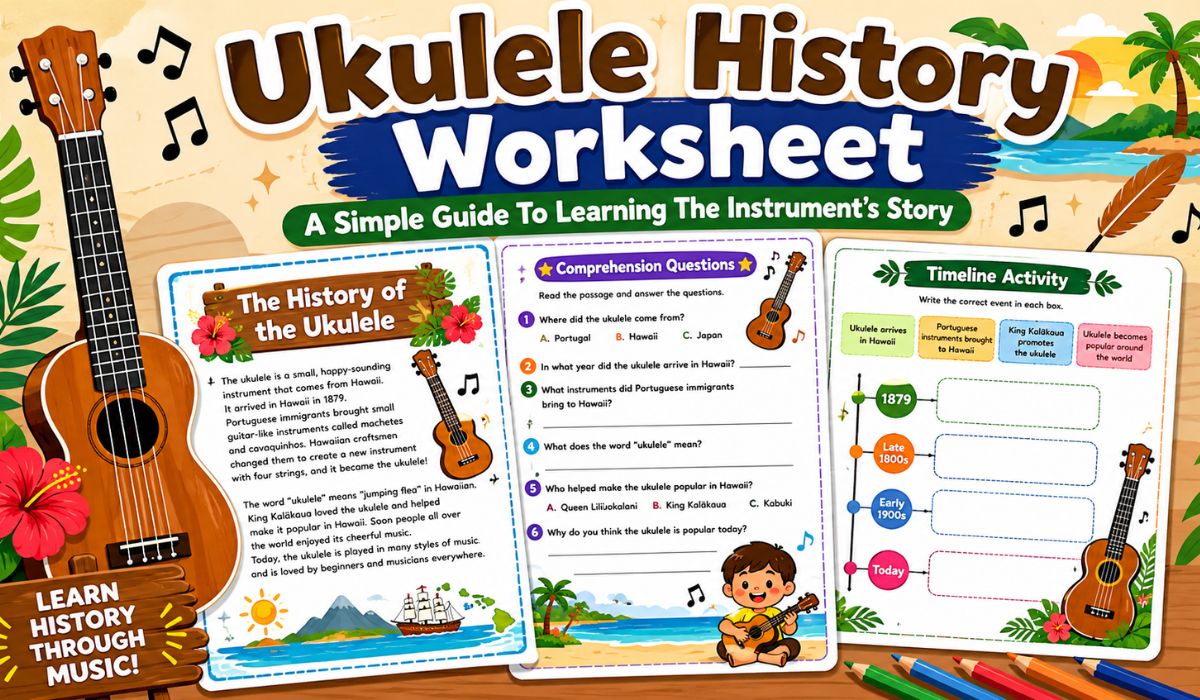
The Ukulele History Worksheet is more than just a classroom activity. It is a simple and engaging way to explore the fascinating story of one of the world’s most loved musical instruments. Whether used in music classrooms, homeschooling lessons, or independent study, a well-designed Ukulele History Worksheet helps students understand how this small instrument became a global musical icon.
The ukulele is often associated with bright Hawaiian melodies and cheerful performances, but its roots stretch much deeper than many people realize. Its journey includes Portuguese craftsmanship, Hawaiian cultural adoption, royal support, and worldwide popularity through modern media. Learning this story gives students a stronger appreciation of the instrument they play.
A thoughtfully created Ukulele History Worksheet connects music education with culture, geography, and history. It transforms simple facts into meaningful lessons. In 2026, as music education becomes more interactive and cross-disciplinary, these worksheets continue to be valuable teaching tools for students of all ages.
Quick Bio Information
Origin
Hawaii
Instrument Family
String Instrument
Cultural Roots
Portuguese And Hawaiian
Arrival In Hawaii
1879
Main Ancestor
Portuguese Machete
Common Meaning
Jumping Flea
Number Of Strings
Four
Standard Tuning
G C E A
Popular Sizes
Soprano, Concert, Tenor, Baritone
Royal Support
King Kalākaua
Global Rise
Early 1900s
Educational Use
Music Classrooms Worldwide
Main Material
Wood
Learning Difficulty
Beginner Friendly
Modern Popularity
Social Media And Online Tutorials
Famous Region
Hawaiian Islands
Playing Style
Strumming And Fingerpicking
Classroom Value
History And Music Education
What Is A Ukulele History Worksheet
A Ukulele History Worksheet is an educational learning resource designed to teach students about the origins, cultural development, and evolution of the ukulele. It usually combines reading passages, historical timelines, reflection questions, and comprehension exercises.
These worksheets are commonly used in music classrooms to support ukulele units. They allow students to learn not only how to play the instrument but also where it came from and why it matters culturally.
Teachers often use them to introduce historical context before beginning practical ukulele lessons. This helps students build a deeper connection with the instrument and understand its significance in world music.
Why Learning Ukulele History Matters
Learning the history of the ukulele gives students a broader understanding of music as part of human culture. Music does not appear suddenly. Every instrument carries a story of migration, innovation, and adaptation.
When students work through a Ukulele History Worksheet, they begin to see how cultural exchange shaped the instrument. This knowledge helps build respect for the traditions connected to it.
Understanding the instrument’s background also encourages more meaningful music learning. Students often feel more motivated when they know the history behind what they are playing.
The Origins Of The Ukulele
The ukulele did not begin in Hawaii. Its roots can be traced to Portugal, where small guitar-like instruments were popular during the nineteenth century.
Portuguese immigrants brought instruments such as the machete, cavaquinho, and rajão when they traveled to Hawaii to work on sugar plantations. These instruments had small bodies and bright tones, making them easy to carry and enjoyable to play.
The ukulele developed from these designs after local Hawaiian craftsmen adapted them to create something unique. This cultural blending is one of the most important facts included in any strong Ukulele History Worksheet.
How The Ukulele Arrived In Hawaii
In 1879, Portuguese immigrants arrived in Hawaii aboard the ship Ravenscrag. Among them were skilled craftsmen and musicians.
One story often shared in historical records tells of a passenger playing a small Portuguese string instrument upon arrival. The fast movement of his fingers reportedly amazed Hawaiian observers.
Soon after, Portuguese craftsmen began building similar instruments in Hawaii. Hawaiian musicians embraced the sound and adapted the design to fit local musical traditions.
This marked the beginning of the ukulele’s transformation into a uniquely Hawaiian instrument.
How Hawaii Shaped The Instrument
Although Portuguese instruments inspired it, Hawaii gave the ukulele its identity.
Local craftsmen refined the shape and tuning. Hawaiian musicians integrated it into traditional songs and performances. The instrument quickly became part of local celebrations and storytelling traditions.
King Kalākaua, who was passionate about preserving Hawaiian arts, played a major role in promoting the ukulele. His support helped establish it as a respected part of Hawaiian culture.
This connection between royalty and music is a fascinating detail often highlighted in a Ukulele History Worksheet.
The Meaning Behind The Name
The word ukulele is commonly translated as “jumping flea” in Hawaiian.
There are different explanations for this unusual name. Some historians believe it describes the fast movement of a player’s fingers across the strings. Others suggest it may have been a playful nickname connected to an early musician.
Regardless of its exact origin, the name has become recognized worldwide and adds charm to the instrument’s identity.
Students often enjoy learning this fun detail, making it an engaging feature of classroom worksheets.
The Ukulele’s Rise Around The World
The ukulele gained international attention in the early twentieth century.
Its popularity grew after Hawaiian performers showcased it at international exhibitions, especially the Panama-Pacific International Exposition in 1915 in San Francisco.
This event introduced many Americans to Hawaiian music and sparked nationwide interest. Soon, ukuleles appeared in popular songs, vaudeville acts, and home music education.
Later, television, film, and internet platforms brought new waves of popularity. In recent years, social media tutorials have introduced millions of new players to the instrument.
What A Ukulele History Worksheet Includes
A high-quality Ukulele History Worksheet often combines reading and interactive activities.
Students may explore historical passages describing Portuguese immigration, answer questions about Hawaiian culture, and complete timelines showing the instrument’s development.
Some worksheets also include vocabulary exercises focused on music history terms. Others encourage students to reflect on how instruments change across cultures.
This combination of reading and participation keeps learners engaged.
Classroom Use In Modern Music Education
In 2026, music teachers use Ukulele History Worksheets as part of blended learning.
Many classrooms combine traditional paper worksheets with digital interactive versions. Students may watch historical videos, complete online quizzes, and explore visual timelines.
These resources are especially useful for substitute teacher lesson plans, independent study periods, and introductory music units.
Because they require minimal equipment, they are practical for schools of all sizes.
Educational Benefits For Students
Using a Ukulele History Worksheet offers more than historical knowledge.
It improves reading comprehension through informational text. It strengthens cultural awareness by teaching students about Portuguese and Hawaiian connections.
It also helps students develop critical thinking by encouraging them to explore how instruments evolve through cultural exchange.
Perhaps most importantly, it builds appreciation for the instrument itself.
Creating A Strong Worksheet
The best worksheets are accurate, clear, and engaging.
They should present historical facts in simple language while including enough depth to challenge students. Visuals such as maps, historical photos, and instrument diagrams can increase understanding.
Good worksheets also balance factual recall with thoughtful questions that encourage reflection.
When creating your own Ukulele History Worksheet, reliable historical sources are essential.
Interesting Facts To Include
A memorable worksheet often includes fun historical details.
The ukulele once became a symbol of American home entertainment during the 1920s.
It experienced a major revival in the 1950s thanks to television personality Arthur Godfrey.
In the 2000s, online performances and viral videos helped introduce the instrument to a new generation.
These details show how the instrument has remained relevant across decades.
Why The Ukulele Still Matters Today
The ukulele continues to thrive because it is approachable, affordable, and joyful to play.
Its simple structure makes it ideal for beginners, while its expressive sound appeals to advanced musicians.
Learning its history reminds students that music connects cultures across time and geography.
A Ukulele History Worksheet helps preserve this understanding and ensures that students appreciate not just how the instrument sounds, but what it represents.
Final Thoughts
The story of the ukulele is one of migration, creativity, and cultural connection. From Portuguese beginnings to Hawaiian transformation and worldwide success, its journey is remarkable.
A thoughtfully designed Ukulele History Worksheet turns this story into a meaningful educational experience. It helps students connect historical facts with musical practice, creating deeper learning and lasting appreciation.
As music education continues evolving in 2026, these worksheets remain powerful tools for teaching history, culture, and musical understanding in a way that feels simple, engaging, and memorable.
FAQs About Ukulele History Worksheet
What Is A Ukulele History Worksheet
A Ukulele History Worksheet is a classroom learning resource that teaches students about the instrument’s origins, development, and cultural importance through reading and activities.
Who Invented The Ukulele
The ukulele was developed in Hawaii by adapting Portuguese string instruments brought by immigrants in the late nineteenth century.
Why Is Ukulele History Important
It helps students understand the cultural roots of the instrument and appreciate how music evolves through cultural exchange.
When Did The Ukulele Arrive In Hawaii
The instrument’s ancestors arrived in Hawaii in 1879 with Portuguese immigrants.
Why Is It Called Ukulele
The Hawaiian word commonly translates to “jumping flea,” likely referring to quick finger movements while playing.
What Grades Can Use A Ukulele History Worksheet
These worksheets are suitable for elementary, middle school, high school, and even adult beginner music education.
How Does A Worksheet Help Students Learn
It combines reading, history, and interactive activities that make learning more engaging and meaningful.
Is The Ukulele Still Popular In 2026
Yes. The ukulele remains highly popular worldwide due to online learning platforms, social media, and classroom music programs.
Recommended For You: Ukulele History Of the World: From Portuguese Roots to Global Fame