
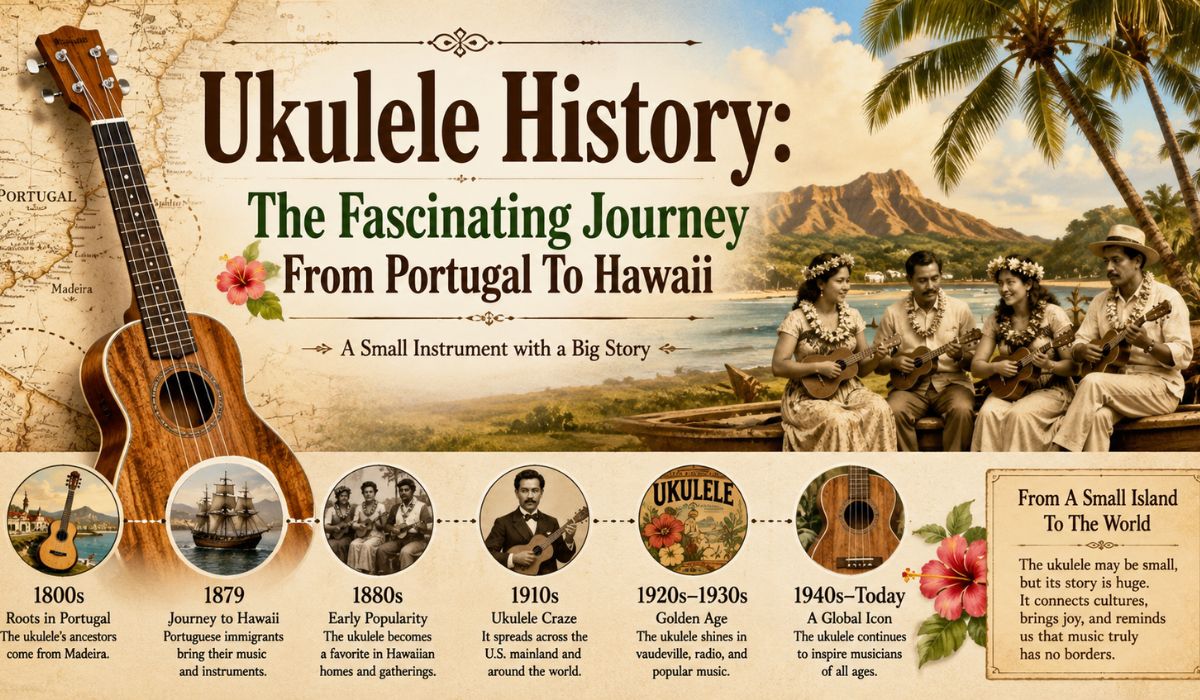
The story of Ukulele History is far more fascinating than many people realize. Today, the ukulele is often seen as a symbol of Hawaii, tropical beaches, and cheerful music. Its bright sound has won the hearts of millions of players around the world. Yet the instrument’s journey began thousands of miles away from the Hawaiian Islands.
The ukulele represents one of the most successful cultural exchanges in music history. It combines Portuguese craftsmanship, Hawaiian creativity, and global influence into a single instrument. From humble beginnings among immigrants seeking a better life to becoming one of the world’s most popular string instruments, the ukulele has experienced an extraordinary journey.
Understanding Ukulele History helps us appreciate not only the instrument itself but also the people, cultures, and historical events that shaped its development. This story includes immigration, innovation, royal patronage, worldwide popularity, periods of decline, and remarkable revival. More than a century after its creation, the ukulele continues to inspire musicians of every age and skill level.
What Is A Ukulele?
Before exploring Ukulele History, it helps to understand what makes this instrument unique. The ukulele is a small member of the lute family of instruments and is closely related to the guitar. Most ukuleles have four strings and produce a bright, warm, and cheerful sound that immediately captures attention.
The instrument is typically available in four primary sizes: soprano, concert, tenor, and baritone. Each size offers a slightly different tone and playing experience. Despite these differences, all versions share the simplicity and charm that have made the ukulele so appealing to beginners and professionals alike.
One reason for the instrument’s lasting popularity is its accessibility. Compared to many other string instruments, the ukulele is relatively easy to learn. Basic chords can be mastered quickly, allowing new players to enjoy making music almost immediately. This combination of simplicity and musical versatility has played an important role throughout Ukulele History.
The Portuguese Roots Of The Ukulele
The true origin of the ukulele begins in Madeira, a beautiful Portuguese island in the Atlantic Ocean. During the nineteenth century, Madeira was known for its rich musical traditions and small string instruments. Among these instruments were the Machete, Braguinha, Cavaquinho, and Rajão.
The Machete was especially important because it closely resembled what would eventually become the ukulele. It featured a small body, four strings, and a bright sound. Local musicians used these instruments to play folk music, dances, and traditional songs throughout Madeira.
Economic hardship, crop failures, and declining industries forced many Madeiran families to seek opportunities elsewhere. At the same time, Hawaii’s growing sugar industry needed workers. These circumstances created a connection that would forever change musical history. Without this migration, the ukulele as we know it today may never have existed.
The Historic Voyage To Hawaii
A defining moment in Ukulele History occurred in August 1879 when the ship SS Ravenscrag arrived in Honolulu. On board were hundreds of Portuguese immigrants from Madeira who had signed contracts to work on Hawaiian sugar plantations.
Among these passengers were three skilled woodworkers: Manuel Nunes, José Do Espírito Santo, and Augusto Dias. Although they initially traveled to Hawaii seeking economic opportunity, they would ultimately become famous for a very different reason.
According to historical accounts, a passenger named João Fernandes celebrated the ship’s arrival by playing and singing with a small Portuguese string instrument. Local Hawaiians were fascinated by both the music and the energetic movement of his fingers. This event has become one of the most famous stories associated with the early development of the ukulele.
The Birth Of The First Ukuleles
After completing their plantation contracts, Nunes, Dias, and Espírito Santo moved to Honolulu and established woodworking businesses. They began building instruments inspired by those they had known in Madeira.
Rather than simply copying Portuguese designs, these craftsmen adapted them to Hawaiian tastes and materials. Historians generally believe the first ukuleles combined the compact body of the Machete with tuning concepts borrowed from the larger five-string Rajão.
The result was a new instrument unlike anything that had existed before. While its roots were clearly Portuguese, its identity quickly became Hawaiian. This blending of traditions is one of the most important themes in Ukulele History and helps explain why the instrument remains culturally significant today.
How The Ukulele Got Its Name
One of the most interesting mysteries in Ukulele History involves the instrument’s name. The most widely accepted translation of the Hawaiian word “Ukulele” is “Jumping Flea.”
Many people believe the name refers to the quick movement of a musician’s fingers across the strings. Observers may have compared the rapid motions to fleas jumping from place to place.
Another theory connects the name to Edward William Purvis, a British officer who served in King Kalākaua’s court. Purvis reportedly had the nickname “Ukulele” because of his small size and energetic personality. While historians continue to debate the exact origin, the “Jumping Flea” explanation remains the most popular and widely accepted interpretation.
King Kalākaua And Hawaiian Culture
No discussion of Ukulele History would be complete without King Kalākaua. Often called the Merrie Monarch, he was one of Hawaii’s strongest supporters of music, dance, and cultural traditions.
During a period when outside influences threatened many Hawaiian customs, Kalākaua actively promoted native arts. He welcomed music into royal gatherings and encouraged performances that included the ukulele. His support helped transform the instrument from a newcomer introduced by immigrants into a respected symbol of Hawaiian culture.
The king’s enthusiasm inspired many Hawaiians to learn and play the instrument. As a result, the ukulele became closely connected with Hawaiian music, storytelling, and community celebrations. This royal endorsement played a major role in the instrument’s rapid rise across the islands.
Early Ukulele Craftsmanship
The earliest Hawaiian ukuleles were remarkable examples of craftsmanship. Builders often used Koa, a beautiful hardwood native to Hawaii. Koa provided excellent sound quality while also giving instruments their distinctive golden appearance.
Unlike many Portuguese instruments that used combinations of different woods, early Hawaiian ukuleles were frequently crafted almost entirely from Koa. These instruments were lightweight yet surprisingly powerful in volume.
Many surviving examples reveal impressive attention to detail. Decorative inlays, elegant body shapes, and carefully carved necks demonstrate the skill of Hawaii’s earliest builders. Their work established standards that continue to influence modern ukulele construction today.
The Event That Changed Everything
A major turning point in Ukulele History occurred in 1915 during the Panama-Pacific International Exposition in San Francisco. Hawaii’s pavilion featured musicians performing traditional Hawaiian music with ukuleles.
Millions of visitors attended the exposition, and many experienced Hawaiian music for the first time. The performances created enormous excitement and introduced the ukulele to audiences across the United States.
Following the exposition, Hawaiian-themed entertainment became extremely fashionable. Music publishers, performers, and instrument makers quickly recognized the growing demand. The ukulele was no longer just a Hawaiian instrument. It was becoming an American sensation.
The Ukulele Craze Of The Jazz Age
The years between the 1920s and 1930s marked one of the most exciting chapters in Ukulele History. Following its successful introduction to mainland audiences, the instrument quickly became a favorite among amateur musicians. Its affordability, portability, and ease of learning made it accessible to people from all walks of life.
During the Jazz Age, sheet music publishers began including ukulele chord diagrams with popular songs. This allowed beginners to play current hits without extensive musical training. Major instrument manufacturers such as Martin, Harmony, and Regal responded to growing demand by producing thousands of ukuleles each year.
The instrument became a common sight in homes, schools, social gatherings, and vaudeville performances. By the end of the 1920s, the ukulele had become one of the most recognizable musical instruments in America. For many families, it represented fun, entertainment, and affordable music-making during a rapidly changing era.
The Post-War Years And Television Popularity
After World War II, the ukulele entered another important phase of growth. Television became a powerful influence on popular culture, and several entertainers helped introduce the instrument to new audiences. One of the most influential figures was Arthur Godfrey, whose television programs regularly featured ukulele performances and lessons.
At the same time, instrument designer Mario Maccaferri introduced inexpensive plastic ukuleles. Millions of these affordable instruments entered the market, making it easier than ever for families to own a ukulele. The instrument also appeared in movies, variety shows, and recordings throughout the 1950s and 1960s.
Hollywood further strengthened the ukulele’s image. Famous performers including Marilyn Monroe played the instrument on screen, helping maintain public interest. During these decades, the ukulele became associated with fun, leisure, and family entertainment across America.
The Years Of Decline
Like many musical instruments, the ukulele experienced changing fortunes. By the late 1960s and throughout the 1970s, rock music dominated popular culture. Electric guitars, amplifiers, and larger bands captured the attention of younger audiences.
Compared to the powerful sound of rock music, the small acoustic ukulele struggled to compete. Many people began viewing it as a novelty item or a beginner’s instrument rather than a serious musical tool. Sales declined, and fewer performers featured the instrument prominently.
Although this period is sometimes called the “Dark Age” of the ukulele, the instrument never completely disappeared. Dedicated enthusiasts, educators, and collectors continued preserving its traditions. Their efforts would eventually help fuel one of the most remarkable musical revivals of modern times.
The Great Ukulele Revival
The modern revival began during the 1980s and accelerated throughout the 1990s. New manufacturers entered the market, producing high-quality instruments for both beginners and experienced musicians. Interest in traditional acoustic music also contributed to renewed appreciation for the ukulele.
A key figure during this period was Jim Beloff, whose books introduced countless players to popular songs arranged for ukulele. By focusing on familiar music, he helped demonstrate that the instrument could be both approachable and versatile.
The Ukulele Orchestra Of Great Britain also challenged old stereotypes by performing sophisticated arrangements that showcased the instrument’s surprising musical range. Their success encouraged audiences to view the ukulele as a serious instrument capable of far more than simple strumming.
Israel Kamakawiwoʻole And Modern Ukulele Legends
Few musicians have influenced modern Ukulele History as deeply as Israel Kamakawiwoʻole. His emotional medley of “Over The Rainbow” and “What A Wonderful World” introduced millions of listeners to the beauty of the ukulele.
The recording achieved global popularity and remains one of the most recognized ukulele performances ever created. Beyond commercial success, it helped reconnect the instrument with its Hawaiian roots while reaching audiences around the world.
Another important figure is Jake Shimabukuro, whose extraordinary technical skill transformed public perceptions of what the ukulele could accomplish. His performances demonstrated that the instrument could handle complex arrangements traditionally associated with guitar, violin, or piano. Together, these musicians helped inspire a new generation of players.
How The Internet Changed Ukulele History
The arrival of the internet brought another major transformation. Online communities, video-sharing platforms, and digital learning resources made the ukulele more accessible than ever before.
One of the most influential moments occurred when Jake Shimabukuro’s performance of “While My Guitar Gently Weeps” became an early viral video. Millions of viewers discovered the instrument through this performance, sparking widespread curiosity.
Today, players can access tutorials, sheet music, lessons, and performances from anywhere in the world. Social media has allowed musicians to share ideas, techniques, and original compositions instantly. As a result, the ukulele community has grown into a truly global network of enthusiasts.
Ukulele History Around The World
Although Hawaii remains central to the instrument’s identity, the ukulele has become a worldwide phenomenon. In Canada, educator J. Chalmers Doane introduced innovative classroom programs that taught thousands of students how to play.
Japan developed one of the largest and most passionate ukulele communities outside Hawaii. Beginning in the early twentieth century, Japanese musicians embraced Hawaiian music and helped establish a thriving ukulele culture that continues today.
The United Kingdom also played an important role. Entertainer George Formby popularized the instrument through films, recordings, and live performances. Today, festivals, clubs, and educational programs exist across Europe, Asia, Australia, and South America, demonstrating the instrument’s universal appeal.
The Evolution Of Sizes, Tunings, And Designs
As the instrument evolved, builders introduced new sizes and designs to meet changing musical needs. The soprano remains the traditional size and is closest to the earliest Hawaiian instruments. Concert, tenor, and baritone models offer larger bodies and deeper tones.
Modern builders have also created bass ukuleles, electric ukuleles, resonator models, and hybrid instruments. These innovations allow musicians to explore new sounds while maintaining the instrument’s familiar character.
The standard tuning of G-C-E-A remains the most popular configuration. However, alternative tunings have expanded creative possibilities. This ongoing experimentation demonstrates that Ukulele History is still being written today.
Why The Ukulele Remains Popular In 2026
In 2026, the ukulele continues to thrive because it offers something unique in the musical world. It is affordable, portable, welcoming to beginners, and enjoyable for experienced musicians. Few instruments provide such a satisfying introduction to music while also supporting advanced performance techniques.
Music educators increasingly use ukuleles in classrooms because students can learn basic skills quickly. Therapists and community organizations also use the instrument to encourage creativity, social connection, and personal expression.
Perhaps most importantly, the ukulele creates joy. Its warm sound and approachable nature encourage people to make music together. This simple quality has remained unchanged throughout its long and fascinating journey.
Conclusion
The story of Ukulele History is a remarkable example of how cultures can come together to create something truly special. What began with Portuguese immigrants carrying small string instruments across the ocean eventually became one of Hawaii’s most beloved cultural symbols.
From the workshops of Manuel Nunes and Augusto Dias to royal gatherings hosted by King Kalākaua, from the 1915 exposition in San Francisco to viral internet performances watched by millions, the ukulele has traveled an extraordinary path. Along the way, it has survived changing musical trends, inspired generations of musicians, and connected people across continents.
Today, the ukulele remains more than just an instrument. It represents creativity, cultural exchange, community, and joy. As new players continue discovering its unique sound, the next chapter of Ukulele History promises to be just as fascinating as the journey that brought it here.
FAQs About Ukulele History
What Is The Origin Of The Ukulele?
The ukulele was developed in Hawaii during the 1880s. It evolved from small Portuguese instruments such as the machete, braguinha, cavaquinho, and rajão, which were brought to Hawaii by immigrants from Madeira.
Why Is The Ukulele Associated With Hawaii?
Although its ancestors came from Portugal, the instrument was transformed and popularized in Hawaii. Hawaiian musicians, builders, and cultural leaders embraced it, making it a lasting symbol of Hawaiian culture.
Who Invented The Ukulele?
No single person can be credited with inventing the ukulele. However, Manuel Nunes, Augusto Dias, and José Do Espírito Santo are widely recognized as the craftsmen who helped develop the earliest Hawaiian ukuleles.
What Does The Word Ukulele Mean?
The most widely accepted translation is “Jumping Flea.” The name likely refers to the fast movement of a player’s fingers across the strings.
Why Did The Ukulele Become Popular In America?
The instrument gained widespread attention during the Panama-Pacific International Exposition in San Francisco in 1915. Hawaiian performers introduced mainland audiences to the ukulele, creating a nationwide craze.
Who Helped Revive The Ukulele In Modern Times?
Several people contributed to the revival, including Jim Beloff, Israel Kamakawiwoʻole, Jake Shimabukuro, and The Ukulele Orchestra Of Great Britain. Their work introduced the instrument to new generations of players.
What Is The Most Common Ukulele Tuning?
The standard tuning is G-C-E-A. Many players remember it using the phrase “My Dog Has Fleas.”
Is The Ukulele Still Popular Today?
Yes. The ukulele remains extremely popular in 2026. It is widely used in music education, live performance, online learning, and recreational music-making around the world.
Recommended For You: Ukulele History Worksheet PDF: A Fun And Easy Way To Learn The Instrument’s Story