
The Ukulele History Timeline is much more than a story about a small four-string instrument. It is a journey through culture, migration, craftsmanship, music, and global connection. Today, the ukulele is loved by beginners, professional musicians, teachers, and hobbyists around the world. Its cheerful sound has become a symbol of joy, creativity, and simplicity. But the instrument’s path to worldwide popularity was not instant. It took more than a century of transformation, adaptation, and reinvention.
From its roots in Portugal to its rise in Hawaii and its eventual spread across the globe, the ukulele has traveled an incredible road. Understanding the History Of The Ukulele helps us appreciate not only the instrument itself but also the cultures and people who shaped it. This complete guide explores the Ukulele History Timeline in depth, covering every major milestone and revealing how this small instrument became one of the world’s most beloved musical companions.
Table of Contents
ToggleQuick Bio Information
Quick Facts About The Ukulele
Birthplace: Hawaii
Roots: Portugal
Original Inspiration: Machete De Braga
Immigration Year: 1879
Official Name Year: 1889
Meaning Of Ukulele: Jumping Flea
Royal Supporter: King Kalākaua
First Major Builders: Nunes, Dias, Espírito Santo
American Breakthrough: 1915
Biggest Boom: 1920s
Major Decline: 1930s
Preservation Center: Hawaii
Revival Year: 1993
Revival Artist: Israel Kamakawiwo‘ole
Modern Star: Jake Shimabukuro
Popular Sizes: Soprano, Concert, Tenor, Baritone
Main Sound: Bright And Warm
Learning Difficulty: Beginner Friendly
Global Status In 2026: Thriving Worldwide
Where The Ukulele Story Truly Begins
Many people assume the ukulele was invented in Hawaii, but its story actually starts in Portugal. During the nineteenth century, Portuguese immigrants from the islands of Madeira and the Azores traveled to Hawaii looking for work in sugar plantations. Along with their families and traditions, they brought music.
Among the instruments they carried was the Machete De Braga, a small four-stringed instrument similar to a miniature guitar. Other related Portuguese instruments, such as the Cavaquinho and Rajão, also influenced what would later become the ukulele.
These instruments were compact, portable, and ideal for singing and social gatherings. That simple design would become the foundation for one of music’s most recognizable instruments.
The Portuguese Instruments That Inspired The Ukulele
The earliest ancestors of the ukulele were crafted in Portugal centuries before the ukulele itself existed. The Cavaquinho was especially important because of its bright sound and small size.
The Machete De Braga contributed the body shape and basic playing style, while the Rajão influenced tuning concepts. Together, these instruments gave Hawaiian craftsmen the blueprint they needed.
Without these Portuguese instruments, the ukulele might never have existed. This connection makes Portugal an essential part of the Ukulele Origin story.
The Arrival In Hawaii
Portuguese immigrants arrived in Hawaii in 1879, bringing their instruments with them. Their music quickly attracted attention among local Hawaiians.
The bright, lively sound of these instruments blended beautifully with Hawaiian musical traditions. Hawaiian musicians began adapting the instruments, reshaping them and tuning them differently.
This cultural exchange marked the true birth of the ukulele.
Hawaii did not simply adopt a foreign instrument. It transformed it.
How The Ukulele Got Its Name
The name Ukulele comes from the Hawaiian language and is commonly translated as “Jumping Flea.”
There are two popular explanations. One says the name refers to the rapid movement of a player’s fingers across the strings. Another story connects the term to Hawaiian royalty, who reportedly used it affectionately.
Either way, the name perfectly captures the instrument’s playful spirit.
This unique name helped establish the ukulele as distinctly Hawaiian, even though its roots were international.
The Influence Of Hawaiian Royalty
One of the most important figures in the Ukulele History Timeline was King Kalākaua, often called Hawaii’s “Merrie Monarch.”
He was passionate about preserving Hawaiian arts and culture. During his reign, traditional music and dance flourished.
The ukulele became a favorite at royal gatherings and celebrations. Because of royal support, the instrument quickly became associated with Hawaiian identity.
Without this cultural embrace, the ukulele may never have become Hawaii’s musical symbol.
The First Great Ukulele Makers
As the instrument gained popularity, early craftsmen began refining its design.
Three names stand out in ukulele history: Manuel Nunes, Augusto Dias, and José Do Espírito Santo.
These immigrant luthiers built some of the earliest true ukuleles in Hawaii. Their instruments set standards for shape, size, craftsmanship, and tone.
Modern ukulele builders still honor their work today.
They were the architects of the instrument’s future.
The 1915 Breakthrough In America
The ukulele’s first major international moment came in 1915 during the Panama-Pacific International Exposition in San Francisco.
Hawaiian musicians performed for American audiences, showcasing hula dancing and ukulele music.
The reaction was immediate.
Americans fell in love with the instrument’s warm tone and cheerful personality.
This event launched the first major Ukulele Craze outside Hawaii.
The Roaring 1920s Ukulele Boom
During the 1920s, the ukulele exploded in popularity across the United States.
Music stores sold affordable models. Schools began teaching it. Families played it at home.
Hollywood also embraced the instrument.
Performers like Cliff Edwards, known as “Ukulele Ike,” helped turn it into a household name.
By the end of the decade, the ukulele was one of America’s most popular instruments.
Why The Ukulele Declined
No instrument stays at the top forever.
In the 1930s and 1940s, musical tastes changed. The guitar became more dominant. Jazz bands grew larger. Later, rock and roll took over.
The ukulele slowly faded from mainstream popularity.
But it never disappeared.
In Hawaii, it remained deeply important in traditional music and cultural celebrations.
Its quiet survival would later fuel its comeback.
The Years Of Preservation
While the world moved on, Hawaii preserved the ukulele.
Musicians continued teaching traditional techniques. Families passed songs between generations.
Artists like Gabby Pahinui and Eddie Kamae helped keep Hawaiian string traditions alive.
These decades protected the instrument’s identity.
Without this preservation period, modern players would have lost access to authentic Hawaiian style.
The Great Revival Of 1993
The biggest modern turning point came in 1993.
That year, Israel Kamakawiwo‘ole released his now legendary version of “Somewhere Over The Rainbow.”
His gentle voice and ukulele accompaniment touched millions.
Suddenly, a new generation discovered the instrument.
The ukulele was no longer old-fashioned.
It felt timeless.
This single recording reignited global interest.
The Internet Changes Everything
In the 2000s, the internet transformed the ukulele world.
YouTube tutorials made learning easy. Social media made sharing music effortless.
Anyone could learn a song in minutes.
This accessibility fueled explosive growth.
Musicians like Jake Shimabukuro showed how advanced the instrument could become, blending jazz, rock, classical, and traditional Hawaiian styles.
The ukulele entered a completely new era.
Why The Ukulele Became So Popular Again
The ukulele’s modern success is not accidental.
It is easy to learn.
It is affordable.
It is portable.
It sounds joyful.
It works in pop, folk, jazz, reggae, and classical music.
For beginners, it feels approachable.
For professionals, it offers creative freedom.
That rare balance explains why the ukulele remains one of the fastest-growing instruments today.
The Ukulele In 2026 And Beyond
Today, the ukulele is stronger than ever.
It appears in classrooms, music festivals, online communities, and recording studios worldwide.
Platforms like YouTube, Instagram, and TikTok continue introducing it to younger generations.
Builders now create premium handmade models, electric versions, and experimental designs.
The future looks bright.
More than a century after its birth, the ukulele continues evolving.
That is what makes its journey so remarkable.
Ukulele History Timeline
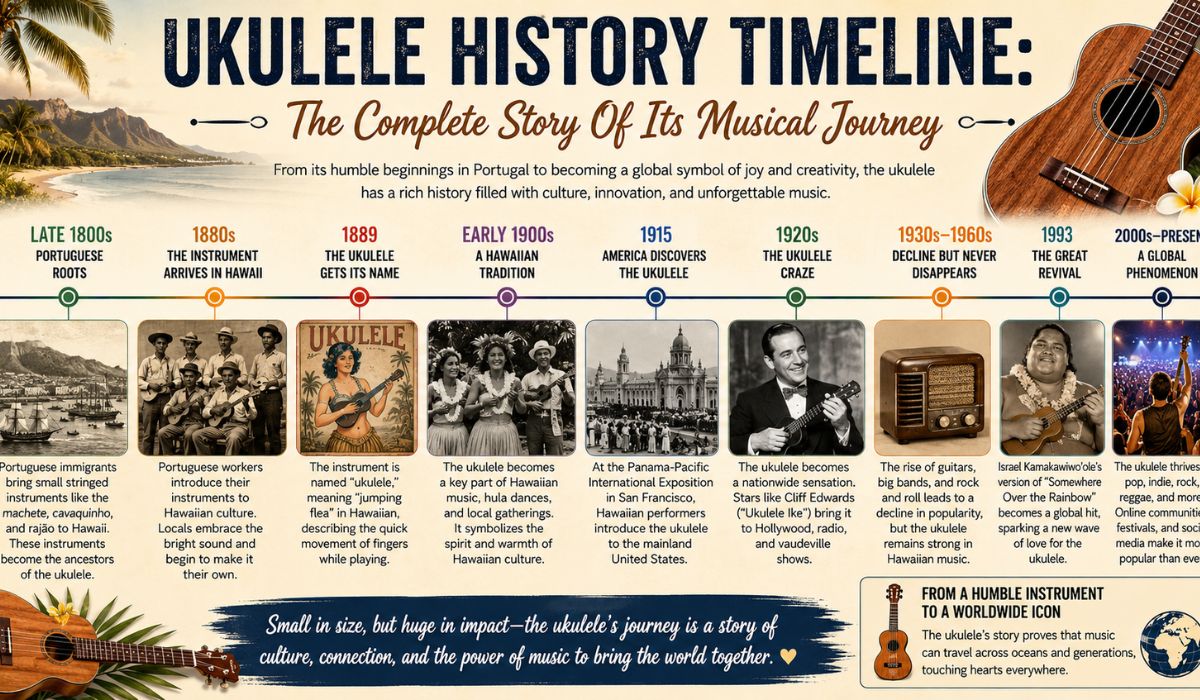
The Ukulele History Timeline can be summarized through its most important milestones.
In 1879, Portuguese immigrants arrived in Hawaii carrying small string instruments.
In the 1880s, Hawaiian musicians began adapting them.
By 1889, the name “Ukulele” was officially recognized.
In 1915, America discovered it during the San Francisco exposition.
The 1920s became the first great ukulele boom.
The 1930s brought decline.
The 1990s brought revival.
The 2000s brought the internet revolution.
The 2020s turned it into a true global musical movement.
Why Its History Matters
Understanding the History Of The Ukulele adds emotional depth to playing it.
Every chord carries a story.
Every melody reflects generations of musicians.
It reminds us that music travels, adapts, and connects cultures.
That is the true beauty of the ukulele.
Conclusion
The Ukulele History Timeline is one of music’s most inspiring stories.
What began as a small Portuguese instrument became a Hawaiian treasure, then an American trend, and finally a global musical symbol.
Its journey shows how culture evolves through creativity and human connection.
The ukulele’s greatest strength has always been its ability to make people smile.
That has never changed.
Whether you are learning your first chord or performing on stage, you are now part of a musical story that began more than a century ago—and that story is still being written.
FAQs About Ukulele History Timeline
Where Did The Ukulele Originally Come From?
The ukulele is strongly linked to Hawaii, but its roots come from Portugal. Portuguese immigrants brought instruments like the Machete De Braga to Hawaii in the late 1800s, where they were adapted into the ukulele.
Why Is It Called Ukulele?
The word “Ukulele” means “Jumping Flea” in Hawaiian. It likely describes how quickly a musician’s fingers move while strumming the strings.
Who Invented The Ukulele?
No single person invented it. The ukulele developed through collaboration between Portuguese immigrants, Hawaiian musicians, and early Hawaiian instrument makers.
When Did The Ukulele Become Popular In America?
The ukulele gained national attention in 1915 at the Panama-Pacific International Exposition and became extremely popular during the 1920s.
Why Did The Ukulele Lose Popularity?
It declined mainly because guitars and newer music styles became more dominant during the 1930s and beyond.
What Brought The Ukulele Back?
The biggest revival came in 1993 when Israel Kamakawiwo‘ole released his famous version of “Somewhere Over The Rainbow.”
Why Is The Ukulele Popular Today?
Its popularity comes from being affordable, beginner-friendly, portable, and easy to learn while still offering advanced musical possibilities.
What Is The Future Of The Ukulele?
The future looks bright. With strong online communities, growing global demand, and continued innovation, the ukulele remains one of the most loved instruments in the world.
Please Read Also: History Of The Ukulele: The Amazing Story Behind Hawaii’s Favorite Instrument