
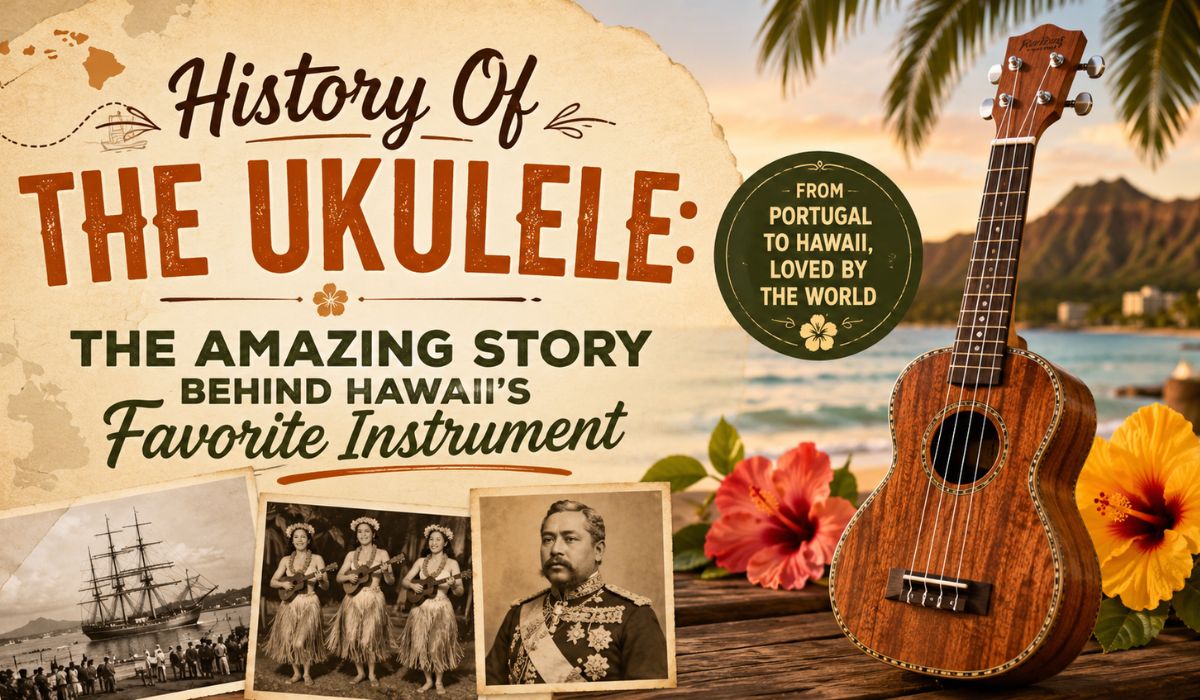
The History Of The Ukulele is one of the most fascinating stories in music. Today, most people immediately connect the ukulele with Hawaii. Its cheerful sound, compact size, and warm island feeling have made it a worldwide symbol of Hawaiian culture. But the real story is much more surprising.
The ukulele did not begin in Hawaii. Its roots stretch across the Atlantic Ocean to Portugal, where small stringed instruments inspired what would later become one of the world’s most loved instruments. When Portuguese immigrants carried their musical traditions to Hawaii in the late nineteenth century, something remarkable happened. Hawaiian musicians embraced the instrument, transformed it, gave it a new identity, and made it their own.
That journey—from Portugal to Hawaii, and then from Hawaii to the rest of the world—is what makes the ukulele’s story so special. In this guide, we will explore the complete History Of The Ukulele, from its earliest ancestors to its modern revival in 2026.
Table of Contents
ToggleQuick Bio Information
Official Name: Ukulele
Meaning: Jumping Flea
Country Of Origin: Portugal
Cultural Home: Hawaii
Birthplace Roots: Madeira
Arrival In Hawaii: 1879
Historic Ship: SS Ravenscrag
Main Ancestor: Machête
Secondary Influence: Rajão
Traditional Wood: Koa
Standard Tuning: G-C-E-A
Popular Sizes: Soprano, Concert, Tenor, Baritone
Royal Supporter: King Kalākaua
Global Breakthrough: 1915 World’s Fair
Oldest Famous Brand: Kamaka
Typical String Count: Four
Sound Style: Bright And Cheerful
Main Symbolism: Hawaiian Culture
Modern Popularity: Worldwide
Status In 2026: Thriving
What Is A Ukulele?
Before exploring its history, it helps to understand what a ukulele actually is. The ukulele is a small stringed instrument that belongs to the lute family. It usually has four strings and is played by strumming or fingerpicking.
Its sound is bright, warm, and instantly recognizable. Unlike larger instruments like the guitar, the ukulele feels approachable. It is lightweight, portable, and beginner-friendly, which explains much of its global appeal.
Today, there are four main sizes: soprano, concert, tenor, and baritone. Each produces a slightly different tone, but all share the same joyful spirit that has defined the instrument for more than a century.
The True Origin Of The Ukulele
The real Origin Of The Ukulele begins on the Portuguese island of Madeira. This volcanic island sits in the Atlantic Ocean and has a long history of woodworking, craftsmanship, and music.
During the 1800s, Madeira was known for its wine industry and skilled artisans. Music was deeply woven into daily life. Street musicians commonly played small stringed instruments in public spaces, filling towns with lively melodies.
This musical culture laid the foundation for what would eventually become the ukulele.
The Portuguese Instruments That Inspired The Ukulele
The ukulele evolved from two Portuguese instruments.
The first was the Machête (Braguinha), a small four-string instrument often played in Madeira. It looked somewhat like a tiny guitar and produced a bright, energetic sound.
The second was the Rajão, which contributed an important tuning style.
Experts believe the modern ukulele borrowed the compact body shape of the machete while adapting the tuning concept from the rajão. This blending created something new—a true musical hybrid.
Why Portuguese Families Moved To Hawaii
The History Of The Ukulele cannot be understood without understanding migration.
In the mid-1800s, Madeira suffered serious hardship. Disease damaged grape crops, the wine economy collapsed, and poverty spread across the island.
At the same time, Hawaii’s sugar plantations needed workers. Plantation owners recruited laborers from around the world, including thousands of Portuguese families from Madeira.
More than 25,000 Portuguese immigrants traveled to Hawaii during this period. They brought clothing, traditions, recipes, and most importantly, music.
The Famous Arrival Of The SS Ravenscrag
One of the most important dates in ukulele history is August 23, 1879.
That was the day the SS Ravenscrag arrived in Honolulu carrying Portuguese immigrants from Madeira.
According to historical accounts, a passenger named João Fernandes celebrated by playing his machete instrument as he stepped onto Hawaiian soil.
Local Hawaiians had never heard anything quite like it. The lively rhythm and bright sound made an immediate impression.
Many historians consider this one joyful performance the unofficial beginning of the ukulele story.
The Three Men Behind The First Ukuleles
Three Portuguese craftsmen are central to the History Of The Ukulele.
Manuel Nunes
Augusto Dias
José do Espírito Santo
These men originally worked on plantations after arriving in Hawaii. Once their contracts ended, they moved to Honolulu and returned to woodworking.
They opened instrument shops and began building guitars, machetes, and eventually the earliest ukuleles.
No one knows who made the very first ukulele. That mystery remains one of music history’s great unanswered questions.
How Hawaii Transformed The Instrument
Although Portugal provided the roots, Hawaii gave the ukulele its true identity.
Hawaiian builders began using Koa wood, a beautiful native wood known for its golden color and bright tone.
Koa made the instrument lighter, louder, and more visually distinctive.
Hawaiian musicians also developed unique playing styles, blending traditional chants, hula rhythms, and island melodies into the instrument’s sound.
This is when the ukulele became unmistakably Hawaiian.
The Meaning Of The Word Ukulele
The word “ukulele” is Hawaiian.
It is commonly translated as “jumping flea.”
“Uku” means flea.
“Lele” means jumping.
Why this name? There are several theories.
Some believe it described a musician’s rapidly moving fingers. Others think it reflected the energetic motion of the instrument during performance.
No one knows for certain, but the name perfectly matches the instrument’s playful personality.
Royal Support Changed Everything
The ukulele’s rise accelerated thanks to Hawaiian royalty.
Kalākaua loved music and encouraged Hawaiian arts.
He welcomed ukulele performances at royal gatherings and personally helped popularize the instrument among Hawaiian citizens.
His court embraced music as a cultural symbol, giving the ukulele prestige and visibility.
Without King Kalākaua, the ukulele may never have become Hawaii’s musical icon.
The Global Breakthrough In 1915
For decades, the ukulele remained mostly Hawaiian.
That changed during the Panama-Pacific International Exposition.
Hawaiian musicians performed for large American audiences, and people were instantly captivated.
Music stores across the mainland began selling ukuleles. Instruction books appeared. Families bought them for home entertainment.
The first global ukulele craze had begun.
The Evolution Of The Ukulele
As popularity grew, the instrument changed.
New sizes appeared, including concert, tenor, and baritone models.
Manufacturing improved.
New playing techniques emerged, including fingerstyle and solo arrangements.
The ukulele moved beyond folk music and entered jazz, pop, classical, and even rock.
Its flexibility helped it survive every musical era.
Famous Ukulele Makers
One name stands above all in Hawaiian craftsmanship: Kamaka Ukulele.
Founded in 1916 by Samuel Kamaka, the company remains one of the most respected ukulele makers in the world.
Kamaka instruments are still handmade in Honolulu and represent a living connection to early Hawaiian craftsmanship.
Other respected makers followed, but Kamaka became a symbol of tradition.
The Modern Ukulele Revival
The ukulele experienced a huge revival in the 2000s and continues growing in 2026.
Artists such as Israel Kamakawiwoʻole introduced the instrument to new audiences.
Social media accelerated learning.
Online lessons made the ukulele easier to access.
Schools embraced it because it is affordable and beginner-friendly.
Today, millions of people worldwide play ukulele.
Its future looks brighter than ever.
Why The Ukulele Still Matters Today
The ukulele is more than an instrument.
It represents migration, cultural blending, creativity, and resilience.
Portugal gave it its beginning.
Hawaii gave it its soul.
The world gave it a future.
That makes the History Of The Ukulele more than music history—it is human history.
Final Thoughts
The journey of the ukulele is extraordinary.
It began in Portuguese streets, crossed oceans aboard immigrant ships, found a new home in Hawaii, and eventually captured the world.
Its story reminds us that culture is never fixed. It grows, travels, and transforms.
That is why the ukulele continues to inspire people in 2026—not just because it sounds joyful, but because its history is joyful too.
Few instruments carry such a beautiful story.
FAQs About History Of The Ukulele
Where Did The Ukulele Originally Come From?
The ukulele originally came from Portugal, specifically the island of Madeira. Portuguese immigrants later brought its ancestor instruments to Hawaii.
Who Invented The Ukulele?
No single inventor is confirmed. Most historians credit Portuguese craftsmen in Hawaii, especially Manuel Nunes, Augusto Dias, and José do Espírito Santo.
Why Is The Ukulele Associated With Hawaii?
Hawaii adopted and transformed the instrument, making it central to Hawaiian music, culture, and identity.
What Does Ukulele Mean?
Ukulele usually means “jumping flea” in Hawaiian, likely referring to fast finger movement while playing.
When Did The Ukulele Reach Hawaii?
The instrument’s ancestors arrived in Hawaii in 1879 aboard the SS Ravenscrag.
What Wood Are Traditional Ukuleles Made From?
Traditional Hawaiian ukuleles are often made from koa wood, a native Hawaiian hardwood prized for its beauty and tone.
Why Did The Ukulele Become Popular Worldwide?
Its small size, easy learning curve, affordable price, and joyful sound helped it spread worldwide.
Is The Ukulele Still Popular In 2026?
Yes. The ukulele remains one of the fastest-growing instruments globally, especially among beginners, students, and online learners.
Please Read Also: Ukulele History Hawaii: The Fascinating Story Behind Hawaii’s Beloved Instrument