
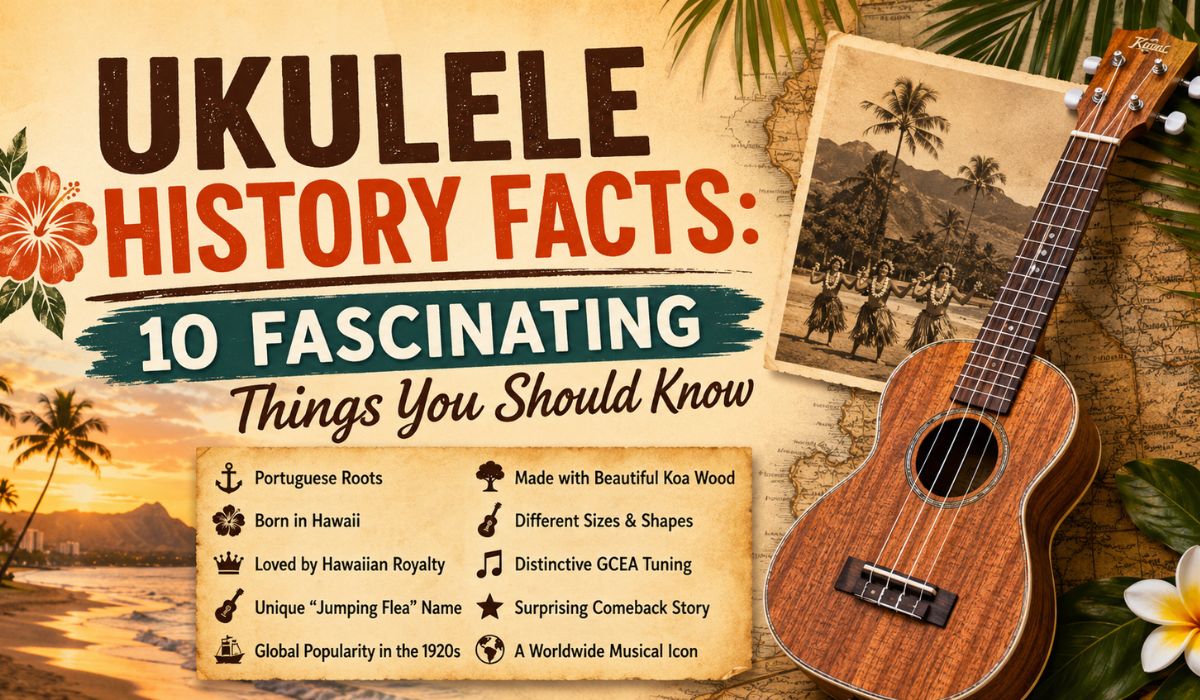
The ukulele may look like a small and simple instrument, but its story is surprisingly rich, global, and deeply meaningful. Today, millions of people know it as a cheerful four-string instrument linked closely with Hawaiian culture, relaxing beach music, and beginner-friendly music lessons. Yet the real history behind it is far more fascinating than most people realize.
The journey of the ukulele includes immigration, craftsmanship, royal influence, cultural pride, musical innovation, and worldwide popularity. It traveled from Europe to the Pacific, transformed in Hawaii, and eventually became one of the world’s most loved instruments. Understanding these Ukulele History Facts helps us appreciate not only the instrument itself but also the people and cultures that shaped it.
In this guide, you will discover the most interesting facts about the ukulele’s origin, its growth, its makers, and its surprising impact on music history.
Quick Bio Information
Instrument Name: Ukulele
Origin: Portugal and Hawaii
Birth Year In Hawaii: 1879
Original Instrument: Machete
Primary Cultural Home: Hawaii
Meaning Of Name: Jumping Flea
Strings: Four
Standard Tuning: G C E A
Baritone Tuning: D G B E
Traditional Wood: Koa
Main Sizes: Soprano, Concert, Tenor, Baritone
Famous Shape: Pineapple
American Popularity Boom: 1920s
Global Revival: 1990s and 2000s
Most Famous Modern Song: Somewhere Over The Rainbow
Known For: Bright Cheerful Sound
Best For: Beginners And Professionals
Common Use: Singing And Strumming
The True Origin Of The Ukulele
Many people believe the ukulele was invented in Hawaii. While Hawaii gave the instrument its identity, its roots actually begin in Portugal.
In 1879, Portuguese immigrants from Madeira arrived in Hawaii seeking work in the sugar plantations. They brought with them a small string instrument called the machete, also known as the braguinha. This tiny guitar-like instrument had four strings and a bright sound.
Hawaiians quickly became fascinated with it. Local musicians and craftsmen began adapting the instrument, changing its size, tuning, and playing style. Over time, this evolved into what we now know as the ukulele.
This is one of the most important Ukulele History Facts because it shows that the instrument is both Portuguese and Hawaiian—a beautiful blend of two cultures.
What Does The Word Ukulele Mean?
One of the most famous ukulele facts is its name.
The Hawaiian word “ukulele” is usually translated as “jumping flea.”
Why such a funny name?
There are two popular explanations. The first is that it refers to the quick movement of a player’s fingers across the strings, which looks like jumping fleas. The second theory suggests it was a nickname given to a Portuguese musician whose energetic playing style impressed Hawaiian audiences.
Although historians still debate the exact origin, “jumping flea” remains the most accepted meaning.
It is one of the most charming parts of ukulele history.
Hawaii Made The Ukulele Famous
Although the instrument came from Portugal, Hawaii turned it into a cultural symbol.
In the late 1800s, Hawaiian royalty embraced the ukulele. King David Kalākaua, often called the “Merrie Monarch,” strongly supported Hawaiian music, dance, and arts.
He promoted the ukulele at royal gatherings and public celebrations. Because of this support, the instrument quickly became part of Hawaiian identity.
Soon, the ukulele was played in homes, schools, festivals, and traditional performances throughout the islands.
Without Hawaii, the ukulele might have remained a small regional instrument. Hawaii gave it a global personality.
The First Ukulele Builders Changed Everything
Three Portuguese craftsmen are often credited with building the first Hawaiian ukuleles.
They were Manuel Nunes, Augusto Dias, and José do Espírito Santo.
These master builders adapted Portuguese designs for Hawaiian musicians. They used local woods, refined body shapes, and improved playability.
Their work laid the foundation for the modern ukulele industry.
Today, these early makers are remembered as pioneers in musical craftsmanship.
Koa Wood Became The Heart Of The Ukulele
One reason vintage Hawaiian ukuleles are so admired is their wood.
Traditional Hawaiian builders often used Koa, a native Hawaiian hardwood known for its beauty and tone.
Koa produces a warm, rich, balanced sound. It also has beautiful natural grain patterns, making each instrument unique.
Because koa grows only in Hawaii and is now carefully protected, koa ukuleles are highly valued by collectors and musicians.
This connection between local materials and musical tradition is a key part of ukulele history.
The Ukulele Comes In More Than One Size
Many beginners think there is only one type of ukulele, but history tells a different story.
The original Soprano ukulele was the first and remains the classic size.
As demand grew, builders created the Concert model in the 1920s for players who wanted more volume and comfort.
Soon after came the Tenor, offering a richer tone and larger fretboard.
In the 1940s, the Baritone appeared, giving players a deeper sound similar to a guitar.
Today, special sizes like bass and sopranino ukuleles add even more variety.
This evolution helped the instrument appeal to different musicians worldwide.
Ukulele Shapes Became More Creative Over Time
Most people recognize the traditional guitar-style ukulele shape.
But history shows that makers experimented with design early on.
One famous example is the Pineapple Ukulele, invented in the 1920s. Its rounded body gave it a louder and fuller tone.
Other unusual shapes include paddle-style ukuleles, square-bodied designs, and modern electric versions.
These creative changes show how flexible the instrument has always been.
The Famous GCEA Tuning Has A Unique Sound
Standard ukulele tuning is G-C-E-A.
This may seem ordinary, but there is something special about it.
The G string is often tuned higher, not lower. This is called re-entrant tuning.
That unusual arrangement gives the ukulele its bright, cheerful, instantly recognizable sound.
The baritone uses a different tuning: D-G-B-E, which matches the top four strings of a guitar.
Understanding tuning helps explain why the ukulele sounds unlike any other instrument.
The Ukulele Took America By Storm
One of the most important moments in ukulele history happened in 1915.
At the Panama-Pacific International Exposition in San Francisco, Hawaiian performers introduced mainland America to Hawaiian music and the ukulele.
The audience loved it.
Soon, music stores across the United States began selling ukuleles.
By the 1920s, the instrument had become a national craze.
Families gathered around to sing with it, and publishers printed thousands of ukulele songbooks.
It was one of America’s first major music trends.
Hollywood Helped The Ukulele Reach The World
As movies became popular, so did the ukulele.
Hollywood used Hawaiian-themed films to introduce global audiences to island music.
The instrument appeared in films, radio shows, and stage performances.
By the mid-20th century, the ukulele was recognized worldwide.
Television later boosted its popularity again through performers like Tiny Tim.
His quirky performances made the ukulele unforgettable for a new generation.
The Ukulele Nearly Disappeared
Not every chapter in ukulele history was successful.
During the rise of electric guitars in the 1950s and 1960s, the ukulele lost popularity.
Rock music dominated.
Many people saw the ukulele as old-fashioned.
Sales dropped, and some makers closed their workshops.
For a time, it looked like the instrument might disappear from mainstream music.
Thankfully, that did not happen.
A Modern Revival Changed Everything
The ukulele’s comeback began in the late 20th century.
A major reason was Israel Kamakawiwoʻole.
His beautiful performance of “Somewhere Over The Rainbow” introduced millions to the instrument.
Later, players like Jake Shimabukuro showed the world how technically powerful the ukulele could be.
Social media, YouTube, and online lessons then helped create a new global wave of ukulele players.
Today, it is stronger than ever.
Why Schools Love The Ukulele
One of the most practical Ukulele History Facts is how useful the instrument is for education.
Teachers love it because it is:
small,
portable,
affordable,
easy on the fingers,
and simple for beginners.
Many schools now choose the ukulele instead of the recorder for music classes.
Children can learn chords quickly and play songs within days.
This has introduced millions of young musicians to music.
Why Learning Ukulele History Matters
Learning the history of the ukulele changes how you see it.
It stops being just a small instrument.
It becomes a story about migration, culture, craftsmanship, creativity, and joy.
Every time someone strums a ukulele, they connect with more than a century of musical tradition.
That makes every note more meaningful.
Final Thoughts
The ukulele may be small, but its story is enormous.
From Portuguese immigrants and Hawaiian kings to modern internet musicians, the instrument has traveled an incredible path.
Its history teaches us how music crosses borders, connects cultures, and survives changing times.
That is why these Ukulele History Facts matter.
They remind us that even the simplest instrument can carry a powerful legacy.
And perhaps that is the ukulele’s greatest lesson—big joy can come from small things.
FAQs About Ukulele History Facts
Is The Ukulele Originally Hawaiian?
Not exactly. The ukulele was developed in Hawaii, but it evolved from Portuguese instruments brought by immigrants from Madeira in 1879. Hawaii transformed it into the instrument we know today.
Why Is It Called Ukulele?
The word “ukulele” usually means “jumping flea” in Hawaiian. Most historians believe this refers to the quick movement of the player’s fingers.
Who Invented The Ukulele?
No single person invented it. It evolved from Portuguese instruments and was developed in Hawaii by early craftsmen like Manuel Nunes, Augusto Dias, and José do Espírito Santo.
When Did The Ukulele Become Popular?
The ukulele first became popular in Hawaii in the late 1800s and then exploded in popularity across America during the 1920s.
Why Is Koa Wood Important In Ukulele History?
Koa is a native Hawaiian wood prized for its beautiful appearance and warm tone. Many traditional and premium ukuleles are made from koa.
What Is The Most Common Ukulele Tuning?
The most common tuning is G-C-E-A, often called standard tuning. It gives the ukulele its signature bright sound.
Why Did The Ukulele Become Popular Again?
Artists like Israel Kamakawiwoʻole and Jake Shimabukuro helped revive interest, while YouTube and online lessons introduced it to new generations.
Is The Ukulele Easy To Learn?
Yes. Its small size, four strings, and simple chords make it one of the easiest instruments for beginners to learn.
Recommended For You: History Of The Ukulele In Hawaii: The Amazing Story Behind Hawaii’s Beloved Instrument