
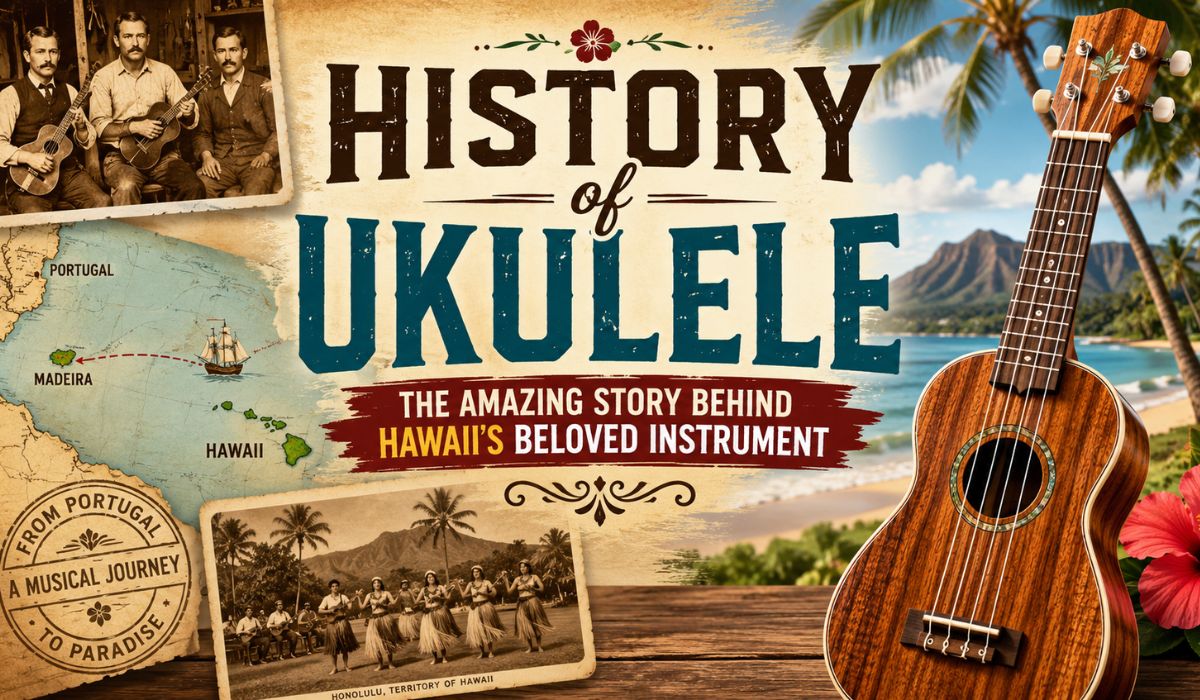
The ukulele is one of the most recognizable musical instruments in the world. Small, cheerful, and full of personality, it instantly brings thoughts of sunshine, beaches, and the warm spirit of Hawaii. For many people, it feels like a purely Hawaiian invention. But the real Historia Ukulele is much more surprising—and far more fascinating.
The story of the ukulele begins thousands of miles away from Hawaii, on a small Portuguese island in the Atlantic Ocean. It involves immigration, craftsmanship, royal support, cultural pride, and an incredible musical journey that transformed a simple folk instrument into a global icon. Today, in 2026, the ukulele is more popular than ever, loved by beginners, professionals, and collectors alike.
To truly appreciate the instrument, it helps to understand where it came from, how it evolved, and why it still matters today. Let’s explore the complete Historia Ukulele, from its earliest roots to its modern-day success.
Table of Contents
ToggleQuick Bio Information
Name: Ukulele
Birthplace: Hawaii
Ancestors: Machéte and Rajão
Original Homeland: Madeira, Portugal
Arrival In Hawaii: 1879
Famous Ship: SS Ravenscrag
Founding Builders: Nunes, Dias, Santo
Traditional Tuning: GCEA
Classic Wood: Koa
Meaning Of Name: Jumping Flea
Royal Supporter: King David Kalākaua
Historic Song: Aloha ʻOe
American Breakthrough: 1915 Exposition
Post-War Promoter: Arthur Godfrey
Modern Revival Icon: Israel Kamakawiwoʻole
Oldest Common Size: Soprano
Newest Family Member: Bass Ukulele
Current Popularity: Global
Main Appeal: Easy To Learn
Cultural Home: Hawaii
The Portuguese Origins Of The Ukulele
The true Historia Ukulele begins in Madeira, a beautiful Portuguese island in the Atlantic Ocean. Long before the ukulele appeared in Hawaii, Madeiran musicians played a small string instrument called the machéte, also known as the machéte de Braga.
This instrument was compact, easy to carry, and perfect for folk music. It had a bright, lively sound and was deeply woven into daily life in Madeira. Alongside the machéte was another important Portuguese instrument called the rajão, a five-string instrument known for its unique tuning style.
These two instruments became the musical ancestors of the ukulele. Without them, the ukulele would never have existed.
Why Portuguese Families Left Madeira
In the late 1800s, life in Madeira became difficult. Economic decline, crop failures, and natural disasters pushed many families into poverty. At the same time, Hawaii’s sugar industry was expanding rapidly and needed workers.
Hawaiian plantation owners offered Madeiran workers contracts that included transportation, housing, and food. For many families, it was a chance to begin again.
Between the 1870s and 1880s, thousands of Portuguese immigrants left Madeira and sailed toward Hawaii, unknowingly carrying the seeds of the ukulele’s future with them.
The Arrival Of The SS Ravenscrag
One of the most famous ships in Historia Ukulele is the SS Ravenscrag, which arrived in Honolulu in 1879.
Onboard were Portuguese immigrants and their families, including a talented musician named João Fernandes. According to popular history, when he stepped off the ship, he began joyfully playing a machéte while dancing across the dock.
Local Hawaiians had never seen or heard anything like it.
That performance may have been the first public moment that sparked Hawaii’s love affair with the instrument.
The Three Fathers Of The Ukulele
Among the immigrants were three skilled craftsmen who would change music history forever.
Manuel Nunes
Augusto Dias
Jose do Espirito Santo
These men were carpenters by trade, but they also understood instrument building. After completing plantation work, they opened workshops in Honolulu and began crafting instruments inspired by the Portuguese machéte.
Today, they are widely remembered as the Fathers Of The Ukulele.
How The First Ukulele Was Created
The first ukulele was not an exact copy of the machéte. It was something new.
Its body shape closely resembled the Portuguese instrument, but its tuning was influenced by the rajão.
G−C−E−AG-C-E-AG−C−E−A
That tuning remains standard today.
Early ukuleles typically had 17 frets and a compact body. They were easier to play than many larger instruments, which helped them spread quickly.
The ukulele was born as a hybrid—Portuguese in origin, but Hawaiian in identity.
Why Koa Wood Changed Everything
One of the biggest differences between early Portuguese instruments and Hawaiian ukuleles was the wood.
In Hawaii, builders began using Koa wood, a native hardwood found on the islands.
Koa is beautiful, durable, and produces a warm, bright sound that became the signature tone of the Hawaiian ukulele.
This was a major turning point. It gave the instrument its unmistakable voice and connected it deeply to Hawaiian culture.
What Does “Ukulele” Mean?
The word “ukulele” is famous, but its meaning remains debated.
The most common explanation is “Jumping Flea.” This likely refers to how a player’s fingers move rapidly across the strings.
Another interpretation came from Liliʻuokalani, who reportedly described it as “A Gift From Afar.”
Both meanings fit beautifully.
One celebrates the instrument’s playful energy. The other honors its immigrant journey.
Royal Hawaiian Support
The ukulele may never have become famous without support from Hawaiian royalty.
David Kalākaua, known as the Merrie Monarch, loved music and promoted the instrument publicly.
He played it at royal gatherings and helped make it part of Hawaiian cultural identity.
His successor, Queen Liliʻuokalani, also supported Hawaiian music and composed the legendary song Aloha ʻOe.
Royal endorsement gave the ukulele prestige and popularity.
The First American Ukulele Boom
The ukulele’s first major breakthrough outside Hawaii came in 1915 at the Panama-Pacific International Exposition.
Hawaiian performers showcased their music and instruments to American audiences, who instantly fell in love with the ukulele.
Demand exploded.
Manufacturers expanded rapidly, and companies like Kamaka became legendary names in instrument making.
This was the beginning of the ukulele’s global rise.
The Post-War Golden Era
After World War II, the ukulele entered another boom period.
American broadcaster Arthur Godfrey frequently played and promoted the instrument on television.
Families bought ukuleles for fun and education.
Meanwhile, instrument designer Mario Maccaferri produced millions of affordable plastic ukuleles, making the instrument accessible to nearly everyone.
For a time, it seemed every household had one.
When Rock And Roll Changed Everything
In the late 1950s, rock and roll changed music forever.
Electric guitars became symbols of youth and rebellion. Compared with flashy new instruments, the ukulele seemed old-fashioned.
Its popularity dropped sharply.
In the mainland United States, many people viewed it as a relic from another era.
But in Hawaii, the ukulele never disappeared.
That cultural loyalty helped preserve it.
The Great Ukulele Revival
In the 1990s, the ukulele made a stunning comeback.
A major reason was Israel Kamakawiwoʻole, whose emotional version of “Somewhere Over The Rainbow” became one of the most beloved recordings in modern music.
His voice and ukulele touched millions.
At the same time, educators like Jim Beloff created books and lessons that made learning easier than ever.
The revival had begun.
The Internet Era And Global Growth
The rise of YouTube and social media transformed ukulele culture.
Suddenly, anyone could learn from home.
Thousands of tutorials appeared online. Viral performances inspired new generations.
During the 2020s, ukulele sales surged worldwide. Schools adopted it. Musicians added it to their collections.
Today, the ukulele is no longer seen as a novelty.
It is respected as a serious instrument.
Modern Ukulele Types
As the instrument evolved, new sizes emerged.
The Soprano Ukulele remains the classic original—small, bright, and traditional.
The Concert Ukulele offers a slightly larger body and fuller sound.
The Tenor Ukulele became popular among performers because of its rich tone and larger neck.
The Baritone Ukulele is deeper and tuned like a guitar.
The Bass Ukulele, introduced more recently, produces surprisingly powerful low tones.
This evolution shows how adaptable the ukulele has become.
Why Historia Ukulele Still Matters Today
The Historia Ukulele is about much more than music.
It is a story of migration, cultural blending, creativity, and resilience.
A small Portuguese folk instrument crossed an ocean, found a new home in Hawaii, and became one of the world’s most beloved instruments.
That journey reflects something powerful about music—it travels, evolves, and connects people across generations and continents.
That is why the ukulele still matters.
Final Thoughts
The ukulele may be small, but its story is enormous.
From the streets of Madeira to the beaches of Hawaii and the stages of the world, it has inspired millions.
Its sound is joyful, its history is rich, and its future remains bright.
As we move through 2026, the ukulele continues to grow—not just as an instrument, but as a symbol of culture, connection, and creativity.
That is the true Historia Ukulele.
FAQs About Historia Ukulele
Where Did The Ukulele Originally Come From?
The ukulele originated in Hawaii, but its roots trace back to Portuguese immigrants from Madeira. They brought instruments like the machéte and rajão, which inspired the first ukulele designs.
Who Invented The First Ukulele?
There was no single inventor. The instrument was developed mainly by Portuguese craftsmen Manuel Nunes, Augusto Dias, and Jose do Espirito Santo in Hawaii during the 1880s.
Why Is The Ukulele Associated With Hawaii?
Although its roots are Portuguese, Hawaii embraced the instrument, adapted it using local materials like koa wood, and made it a major part of Hawaiian culture and identity.
What Does The Word Ukulele Mean?
The most common meaning is “Jumping Flea,” referring to fast finger movement. Another interpretation is “A Gift From Afar.”
Why Did The Ukulele Lose Popularity?
Its popularity declined during the rise of rock and roll in the 1950s, when electric guitars became more fashionable among younger musicians.
Why Did The Ukulele Become Popular Again?
Its revival came through artists like Israel Kamakawiwoʻole, educational efforts, and online learning platforms like YouTube.
What Is The Most Traditional Type Of Ukulele?
The soprano ukulele is considered the original and most traditional version.
Is The Ukulele Still Popular In 2026?
Yes. The ukulele remains highly popular worldwide, especially among beginners, educators, and professional musicians looking for a versatile and joyful instrument.
Recommended For You: History Of Ukulele: The Amazing Story Behind Hawaii’s Beloved Instrument