
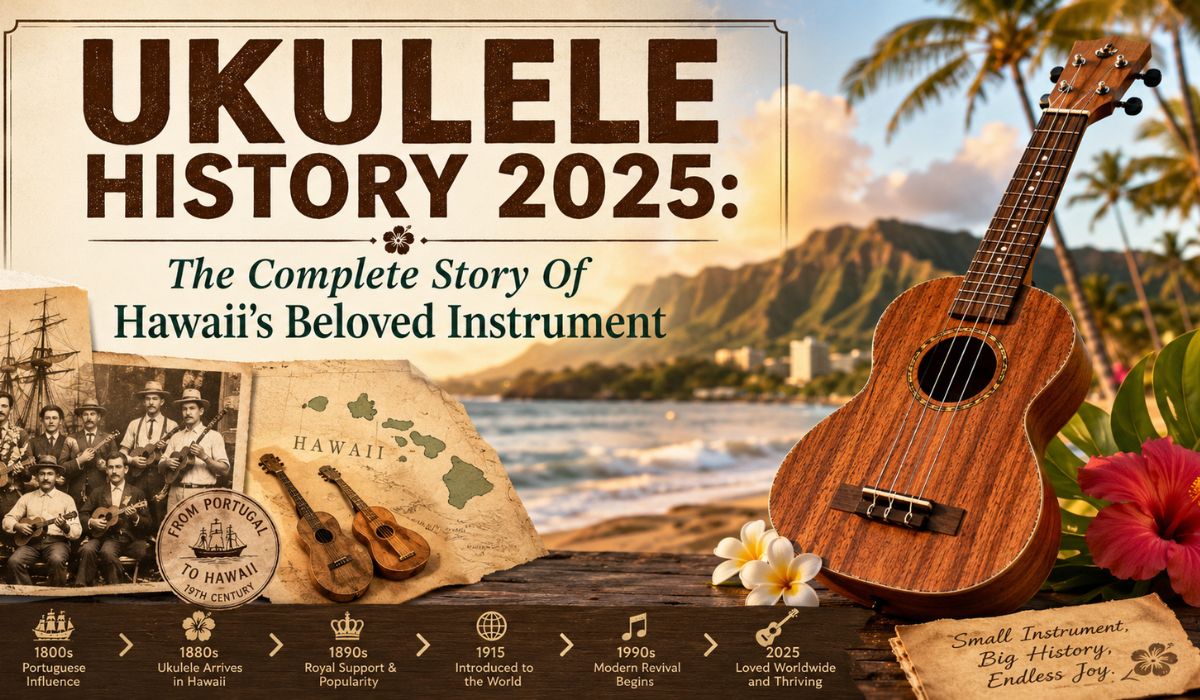
The ukulele may be small, but its story is anything but small. Few musical instruments have traveled such an extraordinary journey—from humble Portuguese roots to becoming one of Hawaii’s most cherished cultural symbols, and eventually winning hearts all around the world. In 2025 and moving into 2026, the ukulele continues to thrive, appearing in classrooms, concert halls, living rooms, and social media feeds everywhere.
Its cheerful sound, compact size, and welcoming nature have made it one of the most approachable instruments ever created. But behind that joyful sound lies a fascinating history filled with migration, cultural blending, royal influence, craftsmanship, and surprising global success. This complete guide to Ukulele History 2025 explores that story in depth—from its earliest beginnings to its exciting modern revival.
Quick Bio Information
Instrument Name: Ukulele
Meaning: Jumping Flea
Primary Origin: Hawaii
Ancestral Origin: Portugal
Birth Period: Late 1800s
Ancestor Instrument: Machete De Braga
Related Instrument: Cavaquinho
Main Strings: Four
Traditional Wood: Koa
Famous Royal Supporter: King David Kalākaua
Major U.S. Breakthrough: 1915
Global Revival: 1990s
Modern Boom: 2000s
Most Famous Modern Song: Somewhere Over The Rainbow
Popular Sizes: Soprano, Concert, Tenor, Baritone
Main Use Today: Education And Entertainment
Current Status In 2025: Globally Popular
Future Outlook: Strong Growth
What Is A Ukulele?
Before exploring its history, it helps to understand what makes the ukulele special. The ukulele is a small, fretted string instrument in the guitar family. It usually has four strings and is known for its bright, warm, and uplifting tone.
Most beginners love it because it feels approachable. It is smaller than a guitar, easier to hold, and often easier to learn. That simplicity is one reason it has remained popular for generations.
Today, the four main sizes are soprano, concert, tenor, and baritone. Each offers a slightly different sound and playing experience, but all share the unmistakable ukulele character people instantly recognize.
The Portuguese Roots Of The Ukulele
Although many people think the ukulele began in Hawaii, its deeper roots actually begin in Portugal.
In the 1800s, Portuguese musicians commonly played small string instruments such as the Machete de Braga and the Cavaquinho. These compact instruments had bright tones and portable designs—qualities that would later define the ukulele.
These Portuguese instruments provided the design foundation, but the instrument would not become the ukulele until it reached Hawaii and evolved there.
How The Ukulele Arrived In Hawaii
The ukulele’s journey changed forever in the late nineteenth century when Portuguese immigrants arrived in Hawaii.
Many came from Madeira to work on sugar plantations. Along with clothing and household items, they brought their musical traditions and beloved instruments.
When these immigrants began playing their small guitars in Hawaii, local residents were immediately captivated by the sound. Hawaiian culture embraced the instrument quickly, and local craftsmen began adapting it, creating what would soon become the modern ukulele.
This cultural blending between Portuguese craftsmanship and Hawaiian creativity gave birth to something entirely new.
Why The Name “Ukulele” Means More Than You Think
The word “ukulele” is one of the most memorable instrument names in the world. In Hawaiian, it is widely translated as “Jumping Flea.”
Most historians believe the name refers to how a player’s fingers seem to jump quickly across the strings.
Some alternative theories exist. A few suggest it may have referred to an energetic player rather than the instrument itself. Regardless of the exact origin, the name perfectly reflects the ukulele’s playful spirit.
The Role Of Hawaiian Royalty
The ukulele’s rise in Hawaii was helped greatly by royal support, especially from King David Kalākaua.
Known as “The Merrie Monarch,” King Kalākaua strongly supported Hawaiian arts, dance, and music. He loved the ukulele and often included it in royal celebrations.
That royal endorsement gave the instrument prestige. It was no longer simply an imported novelty—it became part of Hawaiian identity.
Without this royal influence, the ukulele may never have become such a powerful cultural symbol.
The First Great Ukulele Makers
The earliest ukuleles were shaped by skilled immigrant craftsmen.
Three names stand out in particular: Manuel Nunes, José do Espírito Santo, and Augusto Dias.
These builders transformed Portuguese designs into the recognizable Hawaiian instrument we know today. Their workshops introduced new body shapes, improved construction techniques, and refined sound quality.
Their work laid the foundation for all modern ukulele design.
The Importance Of Koa Wood
One overlooked part of ukulele history is the importance of Hawaiian materials.
Traditional builders often used Koa Wood, a beautiful native hardwood found in Hawaii. Koa offered durability, beauty, and a uniquely warm tone.
Many vintage Hawaiian ukuleles were made from koa, and even today it remains one of the most respected tonewoods in ukulele making.
Its use helped give early Hawaiian ukuleles their distinct sound and visual identity.
The Ukulele Reaches Mainland America
A major turning point came in 1915 during the Panama-Pacific International Exposition in San Francisco.
Hawaiian performers showcased their music and instruments to American audiences. Visitors were enchanted by the ukulele’s sound and charm.
Suddenly, demand exploded. Music stores began selling ukuleles nationwide, and sheet music publishers quickly joined the trend.
This event transformed the ukulele from a Hawaiian treasure into an American sensation.
The Jazz Age And Early Global Popularity
By the 1920s, the ukulele had become a household instrument.
It appeared in Tin Pan Alley music, vaudeville performances, and early jazz bands. Families bought ukuleles because they were affordable and easy to learn.
As recordings and radio spread globally, so did the instrument. It traveled across Europe, Asia, and beyond.
Its first global popularity wave had officially begun.
The Mid-Century Boom
The ukulele reached another major popularity peak in the mid-twentieth century.
Television helped introduce it to new audiences, and performers like Tiny Tim brought it into mainstream entertainment.
His famous performance of Tiptoe Through the Tulips made the ukulele instantly recognizable for a new generation.
Though some viewed it as a novelty instrument during this era, its popularity remained strong.
The Canadian Education Revolution
A remarkable chapter in ukulele history happened in Canada.
Music educator J. Chalmers Doane introduced ukulele programs into schools during the 1960s.
Because the instrument was inexpensive and easy for children to learn, it became ideal for classroom teaching.
At its peak, more than 50,000 students were learning through the program. Later, James Hill helped modernize this educational legacy.
This changed how the world viewed the ukulele—not just as entertainment, but as a serious learning tool.
The 1990s Revival
The ukulele’s next great comeback came in the 1990s.
That revival was led by Israel Kamakawiwoʻole and his unforgettable recording of Somewhere Over the Rainbow/What A Wonderful World.
The song became globally beloved and introduced millions to the emotional power of the ukulele.
For many people, this was their first realization that the instrument could express deep beauty—not just fun and playfulness.
The Pop Culture Explosion Of The 2000s
The early 2000s pushed the ukulele back into mainstream pop culture.
Songs like Hey, Soul Sister and Riptide made its sound unavoidable on radio.
Artists from many genres embraced it. Eddie Vedder even released a full ukulele album.
Then Billie Eilish brought the instrument to younger listeners, even collaborating on the Billie Eilish Signature Ukulele.
The instrument was no longer niche—it was fully mainstream again.
Ukulele History 2025: Why It Is Thriving Today
In 2025, the ukulele is healthier than ever.
Online lessons have made learning easier. Social media has created global ukulele communities. Video platforms allow beginners to learn songs in minutes.
Many people choose the ukulele because it feels welcoming. It does not intimidate beginners. It encourages creativity quickly.
Teachers use it in schools. Adults use it for stress relief. Professional musicians use it in live shows.
That broad appeal explains why Ukulele History 2025 is still being written.
Why The Ukulele’s Legacy Will Continue
Many instruments rise and fade. The ukulele keeps returning.
Its secret is simple. It connects people. It removes barriers. It makes music feel possible for everyone.
Children can play it. Professionals can master it. Families can share it.
Few instruments create joy so quickly.
That is why its future looks bright.
Final Thoughts
The story of the ukulele is really the story of connection—between countries, cultures, generations, and people.
What began as a Portuguese idea became a Hawaiian symbol, then a global musical language.
Today, in 2025 and beyond, the ukulele remains one of the most loved instruments in the world—not because it is complicated, but because it is beautifully simple.
Its history is still being written, and every new player becomes part of that story.
FAQs About Ukulele History 2025
Who Invented The Ukulele?
The ukulele was developed in Hawaii during the late 1800s by Portuguese immigrants and Hawaiian craftsmen. It was inspired by Portuguese instruments but became uniquely Hawaiian.
Why Is The Ukulele Associated With Hawaii?
Although its roots trace back to Portugal, Hawaii embraced and transformed the instrument culturally. Hawaiian royalty and musicians helped make it a national symbol.
What Does Ukulele Mean?
Ukulele usually translates to “Jumping Flea,” likely describing the fast movement of a player’s fingers across the strings.
What Was The First Ukulele Made From?
Early ukuleles were often made from native Hawaiian koa wood, which remains highly prized today for its sound and beauty.
Why Did The Ukulele Become Popular Again?
Its revival came through iconic recordings, pop songs, social media, and online learning platforms that introduced it to new audiences.
Is The Ukulele Still Popular In 2025?
Yes. The ukulele is thriving worldwide thanks to schools, online communities, live performances, and beginner-friendly learning resources.
What Makes The Ukulele Easy To Learn?
Its smaller size, simple chords, and soft strings make it much easier for beginners than many other string instruments.
What Is The Future Of The Ukulele?
The future looks very strong. Growing global communities and digital learning tools suggest the ukulele will remain popular for many years ahead.
Recommended For You: Historia Ukulele: The Fascinating Story Behind Hawaii’s Beloved Instrument