
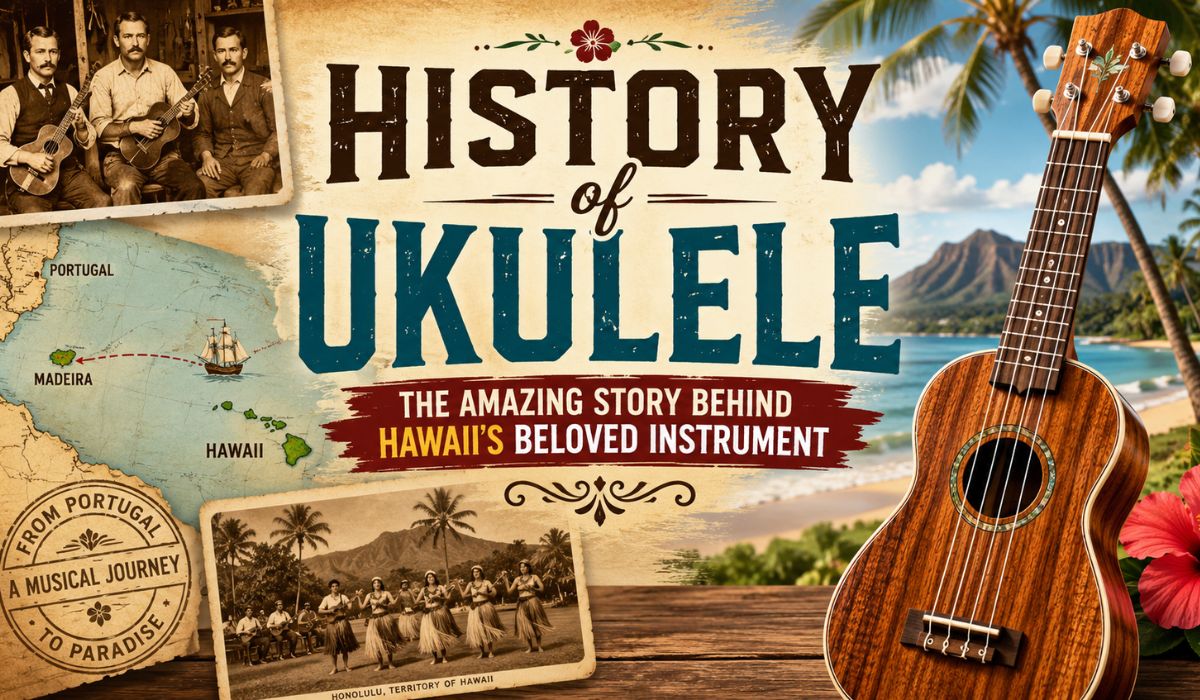
The History Of Ukulele is one of the most fascinating stories in the world of music. Today, the ukulele is closely linked with Hawaii, sunny beaches, and joyful island songs. Its warm, bright sound instantly makes many people think of tropical paradise. But the real story of the ukulele is much more surprising than most people realize.
Many assume this small four-string instrument was invented in Hawaii. In reality, its roots stretch across oceans, beginning in Madeira before finding a new life in Hawaii. Along the way, the ukulele became a symbol of Hawaiian culture, influenced global music trends, and experienced several remarkable revivals. Today, in 2026, it remains one of the most loved and accessible instruments in the world.
This is the complete story of the History Of Ukulele—from its European beginnings to its rise as Hawaii’s beloved instrument and its place in modern music culture.
Quick Bio Information
Instrument Name: Ukulele
Meaning: Jumping Flea
Primary Home: Hawaii
True Origin: Madeira
Ancestor Instrument: Braguinha
Secondary Influence: Rajão
Arrival In Hawaii: 1879
Original Makers: Nunes, Dias, Espírito Santo
Standard Tuning: G-C-E-A
Most Common Material: Koa Wood
Global Breakthrough: 1915 Exposition
First Boom: 1920s
Modern Revival: 1990s–Present
Most Famous Modern Player: Israel Kamakawiwoʻole
Common Sizes: Soprano, Concert, Tenor, Baritone
Typical String Type: Nylon
Musical Style: Hawaiian, Pop, Folk, Jazz
Difficulty Level: Beginner Friendly
What Is A Ukulele?
Before exploring the History Of Ukulele, it helps to understand what makes this instrument special. A ukulele is a small, guitar-like string instrument with four strings, most commonly tuned to G-C-E-A. That tuning is often remembered by musicians as “My Dog Has Fleas.”
Its smaller size makes it lightweight and portable, while its soft nylon strings make it easy to learn, especially for beginners. Today, there are four main types: soprano, concert, tenor, and baritone. Each offers a slightly different sound and feel, but all share the same cheerful musical personality.
Its simplicity is one reason the ukulele has remained relevant for over a century.
Did The Ukulele Really Come From Hawaii?
This is one of the most common questions about the History Of Ukulele. The answer is both yes and no.
The instrument became famous in Hawaii and developed much of its identity there, but it was not originally invented on the islands. Instead, it arrived through immigration and cultural exchange.
That makes the ukulele a perfect example of how music evolves. Sometimes an instrument starts in one place but becomes truly transformed somewhere else. Hawaii did not invent the ukulele—but Hawaii made it what it is today.
Portuguese Roots: Where The Story Truly Begins
The earliest chapter of the History Of Ukulele begins in Portugal, specifically on the Atlantic island of Madeira.
In the 1800s, people in Madeira commonly played a small four-string instrument called the Braguinha, also known as the Machete De Braga. Braguinha
This instrument looked like a miniature guitar and was used to play folk music in homes, streets, and celebrations. It was lively, portable, and affordable—many qualities the modern ukulele still shares today.
The braguinha is widely considered the direct ancestor of the ukulele.
Why Portuguese Families Moved To Hawaii
During the mid-1800s, Madeira faced severe economic hardship. Crop failures, famine, and a collapsing wine industry pushed thousands of families to search for better opportunities elsewhere.
At the same time, Hawaii’s sugar plantations needed workers. Plantation owners began recruiting laborers from Europe, including Portugal.
Between the late 1800s and early 1900s, more than 25,000 Portuguese immigrants arrived in Hawaii. Among them were skilled woodworkers whose lives would change musical history forever.
The Three Men Who Changed Music Forever
Three names appear repeatedly in the History Of Ukulele:
Manuel Nunes
Augusto Dias
José do Espírito Santo
These craftsmen arrived in Hawaii in 1879 aboard the ship Ravenscrag. After finishing plantation work, they returned to their woodworking roots and opened instrument-making shops in Honolulu.
Using their knowledge of Portuguese instruments, they began building versions adapted to Hawaiian preferences. Their craftsmanship laid the foundation for the first true ukuleles.
Without these three men, the ukulele might never have existed.
How The Modern Ukulele Was Born
The ukulele was not copied directly from the braguinha. It evolved.
Its body shape resembled the braguinha, but its tuning was inspired by another Portuguese instrument called the Rajão. Rajão
The result was a smaller, lighter instrument with a bright tone and simple chord shapes.
This design made it ideal for Hawaiian music. It was easy to carry, easy to learn, and loud enough for gatherings, dances, and celebrations.
That blend of Portuguese design and Hawaiian adaptation created the modern ukulele.
Why It Was Named “Ukulele”
One of the most charming parts of the History Of Ukulele is its name.
In Hawaiian, “ukulele” is commonly translated as “jumping flea.”
Most historians believe the name refers to the quick finger movements of players moving across the strings. Others believe it may have described an energetic early performer.
Whatever its exact origin, the name perfectly captures the lively spirit of the instrument.
The Royal Support That Changed Everything
The ukulele might have remained a small immigrant instrument if not for Hawaiian royalty.
King David Kalākaua loved music and cultural arts. Often called the “Merrie Monarch,” he encouraged traditional Hawaiian performance and welcomed the ukulele into royal celebrations.
His support gave the instrument prestige.
Soon it became part of:
hula performances,
royal ceremonies,
community gatherings,
and Hawaiian storytelling traditions.
This royal endorsement helped transform the ukulele into a true Hawaiian symbol.
Why Koa Wood Became Important
A unique part of the History Of Ukulele involves materials.
Early Hawaiian builders used Koa Wood, a native Hawaiian hardwood known for its beauty and rich sound. Koa wood
Koa made the instruments:
lighter,
stronger,
and warmer in tone.
Even today, high-end ukuleles made from koa are considered some of the finest in the world.
This connection to native Hawaiian wood deepened the instrument’s cultural identity.
The Moment The World Discovered The Ukulele
The ukulele’s international breakthrough happened in 1915 at the Panama-Pacific International Exposition in San Francisco.
Visitors heard Hawaiian musicians performing with ukuleles and were captivated.
Suddenly, the instrument became fashionable across mainland America.
People wanted to bring home a piece of Hawaiian culture—and the ukulele became that souvenir.
This event launched the first global ukulele craze.
The Roaring 1920s And The First Ukulele Boom
During the 1920s and 1930s, the ukulele became wildly popular.
Major companies like Sears sold affordable ukuleles through mail-order catalogs, making them accessible to families across America.
Popular entertainers like Cliff Edwards helped make the instrument trendy.
Ukulele chords began appearing in songbooks and sheet music, introducing the instrument to millions of new players.
For a time, almost every household seemed to have one.
The Quiet Years And A New Revival
Like many musical trends, the ukulele eventually faded.
After World War II, electric guitars and rock music took center stage. The ukulele became less visible.
But it never disappeared.
In the late twentieth century, artists like Israel Kamakawiwoʻole brought it back into public attention.
His unforgettable version of Somewhere Over The Rainbow introduced the ukulele to a new generation.
Soon after, schools, YouTube teachers, and social media helped fuel another major revival.
Why The Ukulele Is More Popular Than Ever In 2026
Today, the History Of Ukulele continues to grow.
Its popularity is booming because it is:
easy to learn,
budget-friendly,
portable,
and emotionally uplifting.
Millions of people now learn online through tutorials, apps, and virtual lessons.
The ukulele is common in:
schools,
music therapy,
family gatherings,
professional performances,
and social media videos.
Few instruments have remained so universally loved.
Why The Ukulele Matters Beyond Music
The History Of Ukulele is not only about an instrument.
It tells a story about immigration, adaptation, craftsmanship, and cultural identity.
It shows how people can bring traditions across oceans and create something entirely new.
That is why the ukulele remains emotionally powerful—not just musically useful.
It represents connection.
Final Thoughts
The History Of Ukulele is one of music’s most beautiful journeys.
Born from Portuguese roots, shaped in Hawaii, embraced by the world, and revived again and again, the ukulele has proven that size means nothing when it comes to cultural impact.
Its sound is joyful.
Its story is powerful.
Its legacy continues.
And perhaps that is why this tiny “jumping flea” still captures hearts around the world in 2026.
FAQs About History Of Ukulele
Where Did The Ukulele Originally Come From?
The ukulele originally came from Madeira, Portugal. It evolved from a small Portuguese instrument called the braguinha before being brought to Hawaii by immigrants.
Who Invented The Ukulele?
No single person can be credited. The modern ukulele likely emerged through the work of Manuel Nunes, Augusto Dias, and José do Espírito Santo in Hawaii.
Why Is The Ukulele Associated With Hawaii?
Although it began in Portugal, Hawaiian musicians and royalty embraced it, making it central to Hawaiian music and culture.
What Does Ukulele Mean?
Ukulele means “jumping flea” in Hawaiian, likely referring to the quick movement of a player’s fingers.
Why Is Koa Wood Important In Ukulele History?
Koa wood is native to Hawaii and was used in many early instruments. It became a defining feature of traditional Hawaiian ukulele building.
When Did The Ukulele Become Popular Worldwide?
Its global popularity began after the 1915 Panama-Pacific International Exposition and grew rapidly during the 1920s.
Why Is The Ukulele So Popular Today?
Its easy learning curve, affordable price, and joyful sound make it one of the most popular beginner instruments in the world.
Is The Ukulele Still Growing In Popularity?
Yes. In 2026, the ukulele continues to grow through online learning, education programs, and modern music culture.
Recommended For You: History Of The Ukulele Facts: 10 Fascinating Things You Should Know