
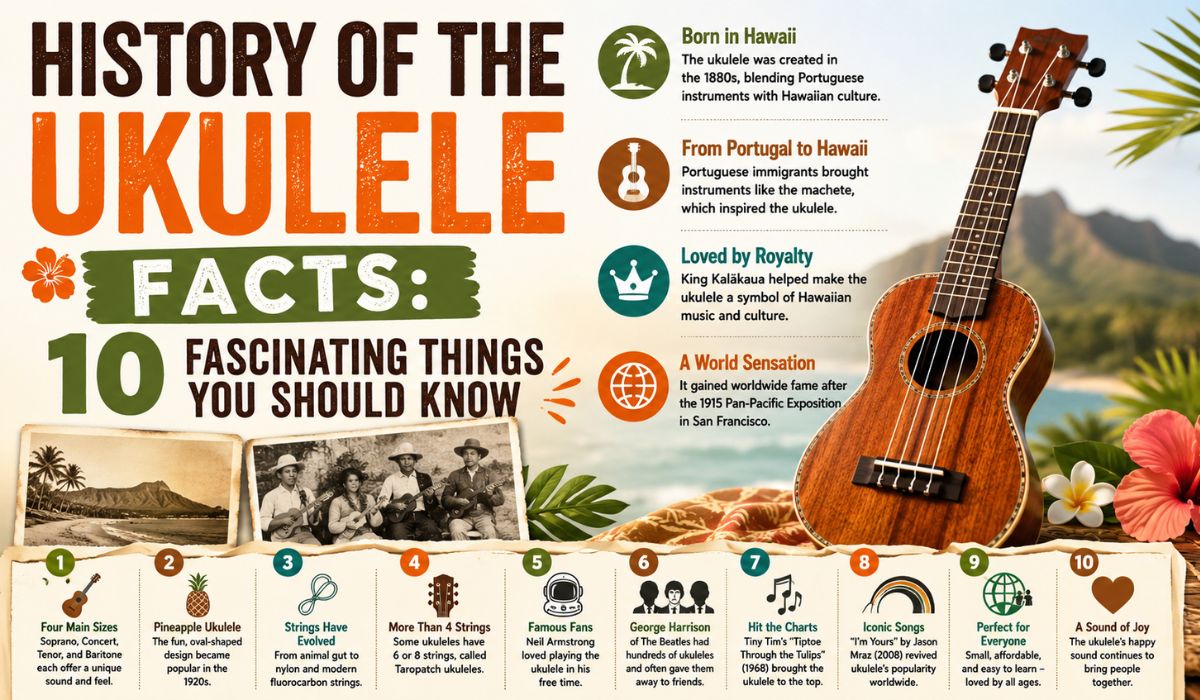
The ukulele may look like a simple little instrument, but its story is much bigger than its size suggests. Today, people all over the world love the ukulele for its cheerful sound, easy learning curve, and deep cultural roots. From children learning their first chords to professional musicians performing on stage, this four-string instrument has become a global favorite.
But where did it come from? Why is it so strongly connected to Hawaii? And how did such a small instrument become one of the most recognized musical tools in the world?
In this guide on History Of The Ukulele Facts, we will explore the complete story of the ukulele—from its surprising origins to its worldwide success. Along the way, you’ll discover fascinating facts, cultural insights, famous players, and hidden details that make the ukulele one of music’s most beloved instruments.
Quick Bio Information
| Fact | Detail |
|---|---|
| Origin | Developed in Hawaii |
| Time Period | 1880s |
| Original Influence | Portuguese Machete |
| Birthplace | Hawaii |
| Meaning Of Name | Jumping Flea |
| Standard Strings | Four |
| Extra Strings | Six Or Eight |
| Famous Shape | Pineapple |
| Traditional Wood | Koa |
| Main Sizes | Four |
| Smallest Standard | Soprano |
| Largest Standard | Baritone |
| Famous Supporter | King Kalākaua |
| Popular Event | 1915 Exposition |
| Famous Fan | Neil Armstrong |
| Celebrity Collector | George Harrison |
| Popular Song | I’m Yours |
| Hawaiian Icon | Israel Kamakawiwoʻole |
The True Origin Of The Ukulele
The history of the ukulele begins in the late 1800s, but not exactly where many people expect. Although the instrument was developed in Hawaii, its roots actually trace back to Portugal.
During the late nineteenth century, many Portuguese immigrants moved from the island of Madeira to Hawaii to work on sugar plantations. They brought with them small stringed instruments, especially one called the machete, also known as the braguinha. This instrument looked like a tiny guitar and had a bright, lively sound.
When Hawaiian people heard this instrument, they loved it. Local craftsmen and musicians began adapting its design, slowly creating what we now know as the ukulele. This blending of Portuguese tradition and Hawaiian creativity gave birth to a completely new instrument.
What The Word Ukulele Really Means
One of the most interesting History Of The Ukulele Facts is its name.
The word ukulele comes from the Hawaiian language and is often translated as “jumping flea.”
At first, that may sound strange, but there are two popular explanations. One suggests that a player’s fingers move so quickly across the strings that they resemble jumping fleas. Another says the nickname may have been given to a Portuguese musician whose energetic playing amazed Hawaiian audiences.
Either way, the name stuck—and today it is recognized worldwide.
Why Hawaii Made The Ukulele Famous
Even though Portuguese immigrants introduced the early instrument, Hawaii gave the ukulele its soul.
In particular, King David Kalākaua played a major role. Known as the “Merrie Monarch,” he strongly supported Hawaiian arts, music, and dance. He encouraged musicians to use the ukulele in royal gatherings and public celebrations.
Because of this support, the ukulele quickly became a symbol of Hawaiian culture. It was no longer just a new instrument—it became part of Hawaii’s identity.
How The Ukulele Spread Across America
The ukulele stayed mostly in Hawaii until the early twentieth century.
Its major breakthrough came during the Pan-Pacific International Exposition in San Francisco. Hawaiian performers played music for large crowds, and audiences immediately fell in love with the ukulele’s happy sound.
After that event, ukulele sales exploded across the United States. Music stores began selling them nationwide, and sheet music publishers started printing ukulele arrangements for popular songs.
By the 1920s, the ukulele had become a household instrument.
The Four Main Ukulele Sizes
Many people think all ukuleles are the same, but they actually come in several sizes.
The Soprano is the smallest standard size and the most traditional. It produces the classic bright ukulele sound.
The Concert is slightly larger and offers a little more room for the hands, making it popular among beginners.
The Tenor is larger still and creates a fuller, richer sound. Many professional performers prefer it.
The Baritone is the largest of the common sizes and sounds deeper, almost like a small guitar.
Each size gives players a slightly different musical experience.
Rare And Unusual Ukulele Sizes
Beyond the four standard sizes, there are some less common versions.
The Sopranino, often called a “pocket uke,” is tiny and produces an extra-bright sound.
At the opposite end are Bass and Contrabass Ukuleles, which are much larger and provide low, deep notes.
These unusual sizes prove just how flexible the ukulele family has become over time.
The Famous Pineapple Ukulele
Not all ukuleles have the traditional figure-eight shape.
One of the most famous alternative designs is the Pineapple Ukulele, which has an oval body. It was created in the 1920s and became popular because it looked playful and tropical.
Its larger body often produces a slightly warmer tone, making it popular with collectors and performers alike.
How Ukulele Strings Changed Over Time
Early ukulele strings were very different from today’s versions.
Originally, players used strings made from animal gut, usually sheep or similar materials. These produced a warm tone but were sensitive to weather and broke easily.
Modern ukuleles mostly use nylon strings, which are stronger and easier to maintain.
Some musicians now prefer fluorocarbon strings, which offer brighter tone and better tuning stability.
This small change helped make the ukulele easier for beginners to enjoy.
The Taropatch Ukulele And Multi-String Designs
Most ukuleles have four strings, but not all.
Some models feature six or even eight strings. These are called Taropatch Ukuleles.
In these instruments, certain strings are paired together, creating a fuller and louder sound. They are especially popular in traditional Hawaiian music.
This is one of the lesser-known but fascinating History Of The Ukulele Facts.
Famous People Who Loved The Ukulele
Many famous people have adored the ukulele.
Neil Armstrong, the first man to walk on the moon during the Apollo 11 Moon Landing, loved playing the ukulele. During his post-mission quarantine, he reportedly spent hours strumming it.
George Harrison was another passionate fan. He owned hundreds of ukuleles and often gifted them to friends.
Their love helped keep the instrument visible in popular culture.
Songs That Made The Ukulele Even More Famous
Music helped bring the ukulele into the spotlight many times.
In 1968, Tiptoe Through the Tulips by Tiny Tim became a massive hit and introduced millions to the ukulele.
In 2008, I’m Yours by Jason Mraz kept ukulele music on radio playlists around the world.
And perhaps no song is more iconic than Over the Rainbow/What a Wonderful World by Israel Kamakawiwoʻole, which introduced a new generation to the instrument.
The Modern Ukulele Revival
The ukulele has experienced an incredible comeback in the digital age.
Platforms like YouTube and TikTok made learning easier than ever. Free lessons, song tutorials, and online communities helped millions pick up the instrument.
Its affordability also helped. Compared to guitars or pianos, ukuleles are inexpensive and beginner-friendly.
Today, schools, music teachers, and hobbyists around the world continue driving its popularity.
Why Beginners Love The Ukulele
One major reason the ukulele remains popular is how easy it is to start.
It only has four strings, which makes chords easier to learn. Its small size makes it comfortable for children and adults alike.
Most beginners can play simple songs within a few days, which creates motivation and confidence.
That quick success keeps new players engaged.
Fun Facts Most People Don’t Know
One surprising fact is that early Hawaiian ukuleles were often handcrafted from Koa wood, a native Hawaiian wood prized for its beauty and tone.
Another little-known fact is that ukulele clubs exist in nearly every major country today, proving just how global this instrument has become.
There is even an annual international celebration called World Ukulele Day, showing how deeply loved this tiny instrument is.
Why The Ukulele Still Matters In 2026
In 2026, the ukulele remains more relevant than ever.
It connects generations. Grandparents teach grandchildren. Teachers use it in classrooms. Musicians use it for songwriting.
Its sound brings joy, simplicity, and warmth—qualities people continue to value in a fast-moving world.
That timeless appeal is why it keeps growing.
Final Thoughts
The story behind the ukulele is much bigger than most people realize. It began with Portuguese immigrants, grew in Hawaiian culture, spread through American popular music, and became a worldwide favorite.
These History Of The Ukulele Facts show that the instrument is more than wood and strings. It represents creativity, cultural exchange, and human connection.
That may be the ukulele’s greatest lesson: sometimes the smallest things can leave the biggest mark on the world.
FAQs About History Of The Ukulele Facts
When Was The Ukulele Invented?
The ukulele was developed in the 1880s in Hawaii after Portuguese immigrants introduced small stringed instruments that inspired its design.
Did The Ukulele Actually Come From Hawaii?
Yes and no. It was created in Hawaii, but its original inspiration came from Portuguese instruments like the machete and braguinha.
Why Is It Called A Ukulele?
The Hawaiian word “ukulele” usually means “jumping flea,” likely referring to the quick movement of a player’s fingers.
What Is The Most Common Ukulele Size?
The Soprano is the traditional and most recognizable ukulele size.
Why Is The Ukulele Connected To Hawaii?
Hawaii embraced and transformed the instrument, making it an important symbol of Hawaiian culture and music.
Who Made The Ukulele Popular Worldwide?
Hawaiian performers, famous musicians, and modern artists like Israel Kamakawiwoʻole and Jason Mraz helped spread its popularity globally.
Is The Ukulele Easy To Learn?
Yes. Its small size, fewer strings, and simple chords make it one of the easiest instruments for beginners.
Why Is The Ukulele Still Popular Today?
Its cheerful sound, affordability, and easy learning curve continue to attract new players around the world every year.
Recommended For You: Ukulele History Facts: 10 Fascinating Things You Should Know